
Moisture is the primary quality contaminant in every industrial compressed air system. Every cubic metre of atmospheric air drawn into a compressor carries water vapour that, once compressed to 7 to 13 bar, becomes an intensely concentrated contamination threat — corroding distribution pipework, destroying pneumatic tools, spoiling pharmaceutical and food products, blocking control instrument valves, and triggering costly unplanned production downtime. For Bangalore’s industrial facilities operating in a climate with year-round relative humidity levels of 50 to 90 per cent, effective compressed air drying is not a supplementary investment: it is the technical foundation of every reliable, high-quality pneumatic system.
ASG Energy Solutions Pvt Ltd, based in Ashwathnagar, Bangalore, has been supplying, sizing, and commissioning Atlas Copco compressed air dryers as part of complete compressed air system installations since 2002. As the authorised Atlas Copco partner in Bangalore, they supply both the FX Series Refrigeration Dryers and the CDX Series Heatless Adsorption Dryers — the two core technologies that address the full spectrum of industrial air quality requirements from ISO 8573-1 Class 4 to Class 1. With 24+ years of application experience across 500+ projects throughout India, ASG Energy Solutions brings sector-specific dryer selection knowledge that catalogue-based suppliers cannot replicate.
This 2026 guide covers the complete technical and commercial landscape of compressed air drying for Bangalore’s industrial sector — from the physics of moisture in compressed air through ISO 8573-1 purity classes, FX and CDX technology deep dives, dryer sizing methodology with Bangalore-specific correction factors, industry-specific selection logic, maintenance requirements, and the energy efficiency considerations that determine whether a dryer investment pays for itself within three years or becomes an operational cost burden for a decade.
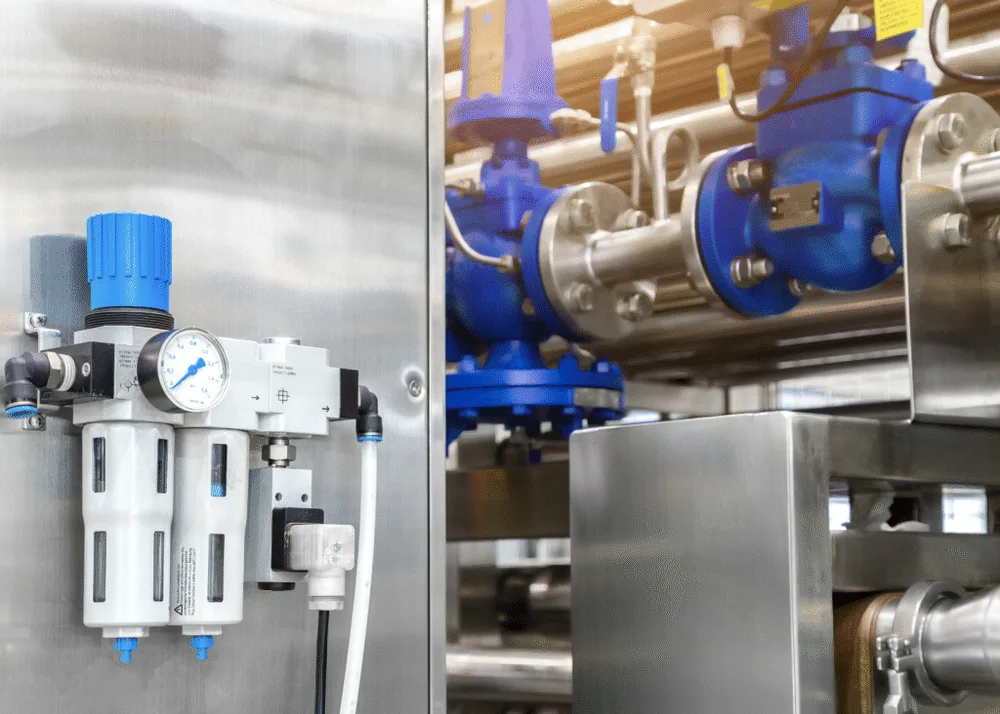
When atmospheric air at 35 degrees Celsius and 80 per cent relative humidity is compressed to 7 bar gauge, the concentration of water vapour increases eightfold relative to its volume. At 7 bar absolute, air that entered the compressor at 80 per cent RH exits the compression stage at a relative humidity of several hundred per cent — meaning that enormous quantities of moisture begin condensing immediately on cooler surfaces downstream. An uncooled, undried 37 kW compressor operating in Bangalore’s climate can introduce 6 to 12 litres of liquid water per hour into the compressed air distribution network during peak humidity periods — moisture that pervades every branch of the network and every connected piece of equipment.
Corrosion is the most widespread and structurally damaging consequence of undried compressed air. Steel distribution pipework exposed to wet compressed air oxidises progressively from the inside, generating iron oxide particles that contaminate the air stream, reduce pipe bore, and ultimately perforate pipe walls — creating uncontrolled leaks. Internal corrosion of pneumatic cylinders, actuators, and control valves increases friction, reduces travel accuracy, and accelerates seal degradation. In Bangalore’s manufacturing sector, replacing corroded compressed air pipework across a large facility can cost Rs. 15 to 50 lakh — a multiple of the entire compressed air dryer investment that would have prevented it.
Product quality failures driven by moisture contamination represent the most expensive category of wet-air consequences for Bangalore’s food, pharmaceutical, and electronics manufacturers. A single batch of pharmaceutical tablets rejected because moisture-contaminated process air introduced microbial contamination during coating can cost Rs. 20 to 80 lakh in write-off, regulatory action, and reputational damage. In electronics assembly, moisture on circuit boards during soldering or cleaning processes creates short circuits and delamination failures that escape visual inspection and appear as early field failures. The total cost of moisture contamination — across equipment damage, quality failures, and regulatory compliance — dwarfs the capital and operating cost of an appropriately specified compressed air dryer by an order of magnitude.
Atmospheric air contains water vapour in proportion to its relative humidity and temperature. At 35 degrees Celsius and 100 per cent RH — the reference inlet conditions specified for Atlas Copco FX and CDX dryers — each cubic metre of air contains approximately 39.6 grams of water vapour in saturated form. When this air is compressed to 7 bar gauge (8 bar absolute), its volume is reduced to approximately one-eighth, concentrating those 39.6 grams of water vapour into a volume that can only hold about 5 grams at saturation. The remaining 34+ grams immediately begin condensing to liquid, releasing latent heat of condensation that further heats the compressed air and complicates downstream temperature management.
After the aftercooler reduces the compressed air temperature to approximately 35 to 45 degrees Celsius, the air remains at or very close to 100 per cent relative humidity and carries the maximum moisture load the cooled air can hold in vapour form. Any further cooling in the distribution pipework, receiver tank, or end-use equipment instantly creates condensation. Without an air dryer to lower the pressure dew point below the minimum temperature in the distribution system, liquid water formation in the compressed air network is not a risk — it is a certainty in Bangalore’s industrial environment.
ISO 8573-1:2010 is the international standard that defines compressed air purity classes across three contamination parameters: particulate matter, water content, and total oil content. For compressed air dryer selection, the moisture class — defined by pressure dew point (PDP) at the dryer outlet — is the determining specification. The standard defines seven moisture classes ranging from Class 0 (better than Class 1, for most critical applications) to Class 6, each corresponding to a specific maximum allowable pressure dew point. Understanding which ISO class your facility’s processes require is the first and most important step in selecting the appropriate dryer technology.
Class 4, corresponding to a pressure dew point of plus 3 degrees Celsius, is the output specification of a refrigeration dryer operating under reference conditions and is the most widely appropriate class for general manufacturing applications in Bangalore. At plus 3 degrees Celsius PDP, the compressed air will not produce condensation unless it is exposed to temperatures below 3 degrees Celsius — a condition that does not occur in Bangalore’s indoor industrial environments, making Class 4 drying genuinely protective for pipework, tools, and most process equipment in the majority of Karnataka’s manufacturing facilities.
Class 2, corresponding to a pressure dew point of minus 40 degrees Celsius, is the minimum requirement for pharmaceutical manufacturing under CDSCO GMP guidelines, food contact compressed air under FSSAI and FSSC 22000 standards, and compressed air used in electronics assembly or outdoor pipework exposed to sub-zero temperatures. Class 2 air produced by an Atlas Copco CDX heatless adsorption dryer contains moisture concentrations so low that biological growth, ice formation, and product contamination are completely eliminated — even in the most demanding process environments. The additional capital and operating cost of CDX technology over FX refrigeration drying is consistently justified in these applications.
ISO Class | Pressure Dew Point | Typical Industrial Application | Required Dryer Technology |
Class 1 | -70 degrees C PDP | Breathing air, critical instrument air, sterile pharma | Heated regeneration adsorption or membrane dryer |
Class 2 | -40 degrees C PDP | GMP pharma, food contact, precision electronics, outdoor pipework | CDX heatless adsorption dryer (standard output) |
Class 3 | -20 degrees C PDP | Control instrument air, outdoor distribution in cold climates | CDX dryer; heated adsorption or blower-purge desiccant |
Class 4 | +3 degrees C PDP | General manufacturing, pneumatic tools, spray painting, textiles | FX Refrigeration Dryer — standard industrial choice |
Class 5 | +7 degrees C PDP | Non-critical general applications where ambient temperature stays above 10 degrees C | Refrigeration dryer (warm-climate basic duty) |
Class 6 | +10 degrees C PDP | Minimal drying requirement; above-ambient indoor distribution only | Aftercooler and moisture separator only; no dedicated dryer required |
Three principal compressed air drying technologies are used in industrial applications: refrigeration drying, desiccant adsorption drying, and membrane drying. Each works on a fundamentally different physical or chemical principle, achieves a different pressure dew point, carries different capital and operating costs, and suits a distinct range of applications. ASG Energy Solutions stocks and commissions two of the three — the Atlas Copco FX refrigeration dryer range and the CDX heatless adsorption dryer range — covering the full spectrum of industrial drying requirements encountered across Bangalore’s manufacturing sector.
Refrigeration dryers cool the incoming compressed air stream to approximately plus 3 degrees Celsius using a refrigerant circuit similar in principle to a domestic refrigerator or air conditioner. At this temperature, the compressed air is cooled below its pressure dew point, causing virtually all the moisture it carries to condense into liquid droplets that are separated and discharged via an automatic condensate drain. The dried, cooled air is then typically passed through a heat exchanger that partially re-warms it using the heat of the incoming warm air — improving thermal efficiency and preventing external pipework condensation downstream of the dryer.
The refrigerant circuit in the Atlas Copco FX dryer series consists of a refrigerant compressor that raises refrigerant pressure and temperature, a condenser that converts the refrigerant from gas to liquid by rejecting heat to the ambient air, a capillary filter that removes particles from the refrigerant circuit before the expansion device, and a hot gas bypass valve that regulates refrigerant flow to the air-to-refrigerant heat exchanger, ensuring stable pressure dew point across varying compressed air loads. This hot gas bypass feature is critical for Bangalore’s manufacturing environments where compressed air demand varies significantly across production shifts — it prevents the dew point from dropping so low that moisture freezes inside the dryer’s heat exchanger.
Refrigeration drying is the most energy-efficient drying technology for ISO Class 4 applications because its only energy input is the electrical power to the refrigerant compressor — typically 0.01 to 0.03 kW per cubic metre per minute of processed compressed air. It produces no compressed air losses, requires no consumable desiccant, and operates at a stable, predictable pressure dew point that does not vary with ambient humidity or inlet air temperature within the normal operating envelope. For the vast majority of industrial applications in Bangalore’s automotive, engineering, textile, and general manufacturing sectors, the FX refrigeration dryer provides the optimal balance of dew point performance, energy consumption, and maintenance simplicity.
Desiccant adsorption dryers use a granular desiccant material — typically activated alumina — that has an extremely high affinity for water molecules, capturing and holding them through a physical adsorption process rather than a chemical reaction. The Atlas Copco CDX series uses a twin-tower configuration: while one tower adsorbs moisture from the live compressed air flow, the other tower is simultaneously being regenerated — having its captured moisture driven off by a flow of dried purge air drawn from the dryer’s own outlet. The towers alternate between adsorption and regeneration duty on a timed cycle, typically every 5 to 10 minutes, providing continuous dry air output.
Heatless adsorption — the technology used in the CDX series — performs regeneration entirely at ambient temperature by depressurising the spent tower and purging it with a flow of dry compressed air from the outlet of the active tower. This is the simplest and most robust adsorption regeneration method, requiring no external heat source, no electrical heating elements, and no complex controls beyond the pneumatically operated tower-switching valves and a timing controller. The CDX design incorporates wide desiccant vessels for low air velocity and high contact time, pneumatically operated switching valves with integrated silencers and safety valves, robust frame construction with forklift slots, and an integrated filter pack — all features that contribute to the CDX’s reputation for reliable operation in demanding industrial environments across Bangalore’s manufacturing sector.
The operating cost of heatless adsorption drying is dominated by purge air consumption — approximately 15 per cent of the dryer’s rated inlet flow is continuously directed through the regenerating tower and exhausted to atmosphere. This purge loss is not recoverable: it is compressed air generated at the compressor’s full energy cost that performs no useful work in the facility. For a facility with a 37 kW compressor producing 6 cubic metres per minute of compressed air, a CDX dryer consumes approximately 0.9 cubic metres per minute as purge air — equivalent to approximately 5.5 kW of continuous compressor loading dedicated solely to dryer regeneration. This purge cost is easily justified by the product quality and regulatory compliance value of Class 2 dry air in pharma, food, and electronics applications, but is unnecessary and disproportionately expensive in general manufacturing applications where Class 4 drying is entirely adequate.
A third drying technology — heat of compression (HOC) drying — is available for facilities operating Atlas Copco oil-free compressors. HOC dryers exploit the significant heat generated during the two-stage compression process in oil-free machines to regenerate the desiccant bed, requiring neither electrical heating elements nor purge air. This zero-purge approach eliminates the 15 per cent compressed air loss of heatless adsorption while still achieving the ultra-low dew points required for pharmaceutical and food applications. HOC systems are typically specified for larger oil-free installations above 90 kW where the combination of high purge air cost and critical air quality requirements makes the additional capital investment in HOC technology financially compelling.
The Atlas Copco FX series refrigeration dryers represent the industry benchmark for general-duty industrial compressed air drying. Supplied by ASG Energy Solutions as the authorised Atlas Copco partner in Bangalore, FX dryers deliver a steady pressure dew point of plus 3 degrees Celsius across the full rated flow range, with no risk of moisture entering the downstream compressed air system and no risk of freezing within the dryer’s heat exchanger at normal operating loads. The steady, predictable dew point output of the FX series — maintained by the hot gas bypass circuit regardless of inlet air load variations — is a critical operational advantage over budget dryers that produce acceptable dew points at full load but deteriorate significantly at partial load.
The FX dryer’s refrigerant circuit design eliminates the two failure modes most common in budget refrigeration dryers operating in Bangalore’s high-ambient-temperature environment. First, the capillary filter protects the expansion device from refrigerant-borne particles that otherwise progressively block the expansion orifice and cause compressor-side refrigerant flooding — the most common refrigerant circuit failure mode in industrial dryers operating in dusty industrial environments like Peenya and KIADB zones. Second, the hot gas bypass valve prevents the air-to-refrigerant heat exchanger from reaching the water freezing temperature during light-load operation — a failure mode that blocks the heat exchanger with ice, causes compressed air bypass and uncontrolled moisture carry-over, and can damage the heat exchanger through ice expansion if not cleared promptly.
For facilities where compressed air quality monitoring is required — pharmaceutical, food processing, or export-supply manufacturers requiring documented ISO 8573-1 compliance evidence — the FX dryer can be integrated with ASG Energy Solutions’ CAEMS monitoring platform to provide continuous dew point measurement and recording at the dryer outlet. CAEMS trend data on outlet dew point provides early warning of refrigerant circuit degradation, dryer overloading from facility expansion, or increased inlet air temperature that may be pushing the dryer beyond its rated performance envelope — enabling proactive service intervention before air quality falls below the ISO class requirement.
Atlas Copco FX dryers are rated at reference conditions of 35 degrees Celsius inlet air temperature, 7 bar(g) inlet pressure, and 100 per cent relative humidity. In Bangalore’s industrial environment, inlet air temperature at the dryer inlet is critically important because the refrigeration circuit’s heat rejection capacity is fixed — if the compressed air arrives at the dryer inlet significantly hotter than 35 degrees Celsius, the refrigerant circuit cannot cool it to the target plus 3 degrees Celsius PDP. During Bangalore’s peak summer months from March to May, ambient temperatures reaching 36 to 40 degrees Celsius mean that aftercooler outlet temperatures of 40 to 50 degrees Celsius are not uncommon. At these elevated inlet temperatures, an FX dryer rated at reference conditions may only achieve a dew point of plus 6 to plus 8 degrees Celsius — shifting the air quality from ISO Class 4 to Class 5, which may be inadequate for the application.
The solution to high-ambient-temperature performance limitation is to apply the manufacturer’s correction factor table when sizing the FX dryer for Bangalore installations. If the inlet temperature will regularly exceed 35 degrees Celsius, the dryer must be selected at a higher nominal capacity than the compressor’s FAD alone would suggest — typically 10 to 20 per cent oversizing per 5 degrees Celsius of excess inlet temperature. ASG Energy Solutions applies these correction factors as standard practice in every FX dryer specification for Bangalore clients, ensuring that the delivered air quality meets the ISO class requirement throughout the year rather than only during cooler months.
The Atlas Copco CDX Series heatless adsorption dryers are designed for maximum performance and reliability in the most demanding industrial compressed air applications — where Class 2 dew point at minus 40 degrees Celsius is required consistently throughout the operating year, and where a momentary dew point excursion would constitute a product quality or regulatory compliance failure. Supplied by ASG Energy Solutions as part of complete compressed air systems for Bangalore’s pharmaceutical, food processing, and electronics manufacturing sectors, CDX dryers combine the reliability of Atlas Copco engineering with a robust physical design specifically optimised for continuous industrial duty.
The CDX range operates under reference conditions of 35 degrees Celsius inlet temperature, 100 per cent relative humidity, and 7 bar(g) inlet pressure for the 11-bar series variants, and 12.5 bar(g) for the 16-bar variants. The twin-tower architecture uses wide desiccant vessels that maintain low air velocity through the desiccant bed — a key design feature that protects desiccant granules from attrition, extends desiccant service life, and ensures complete moisture adsorption by maximising the contact time between the compressed air and the desiccant surface. Pneumatically operated switching valves manage the tower changeover between adsorption and regeneration duty, with integrated silencers on the regeneration exhaust outlets and safety valves to protect each tower against overpressure during pressurisation and depressurisation cycles.
The integrated filter pack in the CDX series is a particularly significant design feature for Bangalore’s industrial operators. Desiccant adsorption dryers require an upstream pre-filter to remove oil aerosol from the compressed air before it contacts the desiccant bed — oil contamination of activated alumina rapidly blocks its adsorption capacity, reducing dew point performance and requiring premature desiccant replacement at significant cost. The CDX’s integrated pre-filter eliminates the need to separately specify, purchase, and install an upstream oil removal filter, simplifying the overall system configuration and ensuring that the critical oil contamination protection is always in place from the day of commissioning.
The 15 per cent purge air consumption of heatless adsorption dryers represents a continuous compressed air loss that must be accounted for in the compressed air system design from the outset. If the upstream compressor and receiver have been sized only to meet the facility’s process demand — without including the dryer’s purge air requirement — the system will be unable to maintain adequate pressure during production while simultaneously regenerating the CDX dryer. ASG Energy Solutions includes the dryer purge air requirement as an explicit load in every compressed air system design where a CDX dryer is specified, ensuring that the compressor is sized to meet total flow including purge from day one.
Demand-controlled purge systems, available as an option on higher-specification desiccant dryer ranges, reduce purge air consumption by monitoring the actual moisture load on the desiccant bed and extending the adsorption cycle when inlet air humidity is lower than reference conditions. In facilities where compressed air demand is intermittent — such as batch process pharmaceutical plants or food packaging operations running single-shift — demand-controlled purge can reduce average purge consumption to 6 to 10 per cent of rated flow, significantly reducing the energy cost of achieving Class 2 air quality. ASG Energy Solutions can advise on the applicability of demand-controlled purge for specific facility operating profiles during the pre-design consultation.
The choice between an FX refrigeration dryer and a CDX heatless adsorption dryer is not a matter of quality preference — it is a technical decision driven by the downstream air quality requirement, as defined by the ISO 8573-1 class mandated for the application. Specifying a CDX adsorption dryer for a general manufacturing facility that requires only ISO Class 4 is a costly over-specification that adds unnecessary capital cost and purge air energy waste. Conversely, specifying an FX refrigeration dryer for a pharmaceutical cleanroom that requires ISO Class 2 is a compliance failure that may not become apparent until a CDSCO inspection or batch quality failure creates a costly and reputational crisis.
The correct selection framework begins with identifying the most demanding air quality requirement in the facility — the process or application that requires the lowest pressure dew point. If that requirement is ISO Class 4 (plus 3 degrees Celsius PDP), an FX refrigeration dryer is the right and most cost-effective technology. If any process requires ISO Class 2 (minus 40 degrees Celsius PDP) or better, a CDX heatless adsorption dryer is required for those processes, either as the single dryer for the whole system or as a dedicated branch dryer serving only the critical processes. ASG Energy Solutions’ system design methodology evaluates each process in the facility individually, maps them to their ISO class requirements, and specifies the minimum dryer technology that satisfies all requirements — avoiding both under-specification and expensive over-specification.
Feature | FX Refrigeration Dryer | CDX Heatless Adsorption Dryer |
Drying Technology | Refrigerant circuit cools air to +3 degrees C PDP | Activated alumina desiccant bed adsorbs water vapour |
Outlet Dew Point | +3 degrees C PDP (ISO Class 4) | -40 degrees C PDP standard (ISO Class 2) |
Energy Consumption | Electrical only (refrigerant compressor); 0.01-0.03 kW per m3/min | Electrical (control only) + 15% purge air loss from processed flow |
Operating Cost Driver | Electricity for refrigerant compressor | Compressed air loss for regeneration (15% of rated flow) |
Best Suited For | General manufacturing, pneumatic tools, spray booths, automotive | Pharma, food contact, electronics, outdoor below-zero pipework |
Maintenance Frequency | Annual refrigerant circuit check; condensate drain service | Desiccant replacement every 3-5 years; valve and sieve check annually |
Inlet Conditions (Reference) | 35 degrees C inlet temp; 7 bar(g) inlet pressure; 100% RH | 35 degrees C inlet temp; 7 bar(g) for 11-bar variants; 12.5 bar(g) for 16-bar variants |
Capital Cost | Lower (standard industrial equipment) | Higher (twin-tower desiccant vessels, pneumatic valves, controls) |
Freeze Risk to Downstream | None — PDP +3 degrees C; moisture held above zero | None — PDP -40 degrees C; moisture eliminated completely |
Correct compressed air dryer sizing requires matching the dryer’s rated flow capacity at actual site conditions to the compressor’s maximum free air delivery — with correction factors applied for any deviation of site conditions from the manufacturer’s reference rating conditions. For FX refrigeration dryers, the four key sizing parameters are inlet air flow rate (matched to compressor FAD), inlet air temperature (the most critical Bangalore-specific factor), inlet air pressure, and ambient temperature in the dryer installation room.
Inlet air temperature correction is the most significant sizing adjustment for Bangalore installations. The Atlas Copco FX dryer range is rated at a reference inlet temperature of 35 degrees Celsius. During Bangalore’s summer months from March to May, and in any installation where the compressor room is poorly ventilated, inlet temperatures of 40 to 50 degrees Celsius are common. An FX dryer selected at its nominal FAD rating under these conditions will deliver a dew point significantly warmer than plus 3 degrees Celsius — potentially failing to achieve ISO Class 4. The correction factor for elevated inlet temperature requires selecting the next larger dryer model and verifying that the increased capacity at the elevated temperature still delivers the required dew point from the manufacturer’s selection table.
For CDX heatless adsorption dryers, the primary sizing consideration beyond inlet flow matching is the purge air allowance. The dryer inlet flow rating in the manufacturer’s catalogue represents the net useful output — the 15 per cent purge air consumed by regeneration is in addition to this rated capacity. The upstream compressor must therefore be sized to deliver the facility’s process demand plus the dryer’s purge consumption. For a CDX dryer treating 5 cubic metres per minute of compressed air, the compressor must supply 5.75 to 5.88 cubic metres per minute to simultaneously maintain process supply and regeneration. ASG Energy Solutions builds this additional flow requirement into every CDX dryer installation design as a standard sizing step.
A compressed air dryer does not function in isolation — it is one element of a layered filtration and drying system that must be designed as a complete package to achieve the target ISO 8573-1 purity class at the point of use. The effectiveness of both the FX refrigeration dryer and the CDX adsorption dryer depends critically on the condition of the compressed air entering them — specifically its oil content, particulate level, and temperature. Compressed air that arrives at the dryer inlet carrying excess oil aerosol, solid particles, or elevated temperature significantly degrades dryer performance, shortens service life, and may produce outlet air quality well below the specified ISO class.
An upstream oil removal coalescing filter is mandatory before both FX and CDX dryers to remove the residual oil aerosol carried in the compressed air from oil-injected compressors. Oil in the compressed air stream coats the surfaces of the FX dryer’s heat exchanger over time, progressively reducing its heat transfer efficiency and degrading dew point performance. For CDX adsorption dryers, oil contamination of the desiccant bed is a more immediate and severe problem: even small quantities of oil can permanently coat the activated alumina granules, blocking their moisture adsorption sites and causing rapid dew point deterioration. The integrated filter pack in the CDX series addresses this risk specifically, but proper upstream coalescing filtration remains essential for system longevity.
An after-filter is recommended downstream of both dryer types to remove any desiccant fines (from the CDX) or condensate particles (from the FX) that may be entrained in the dried air stream before it enters the distribution network. After-filters for refrigeration dryers are typically general-purpose particulate filters; after-filters for CDX adsorption dryers include an activated carbon stage to remove any trace hydrocarbon vapours that passed the pre-filter, ensuring the ISO 8573-1 oil content class as well as the moisture class is met at the point of use. ASG Energy Solutions specifies the complete filter-dryer-filter package as an integrated system, not as individual components — ensuring that the air quality at the distribution network inlet genuinely achieves the specified ISO class under all operating conditions.
A dryer specified without appropriate upstream and downstream filtration does not deliver its rated ISO class at the point of use. This is the most common air quality failure mode in compressed air systems that have been built incrementally — adding a dryer to an existing system without adding the appropriate complementary filters. ASG Energy Solutions’ compressed air system audits frequently identify situations where a correctly sized and functioning dryer is producing clean, dry air at its outlet, but that air quality is being compromised by contamination entering the distribution network from corroded pipework, bypassed filters, or inadequate pre-filtration upstream of the dryer. The complete system — compressor, aftercooler, pre-filter, dryer, after-filter, receiver, and distribution network — must be evaluated and specified together.
Bangalore’s diverse industrial landscape creates a wide range of compressed air quality requirements that span from ISO Class 4 general manufacturing applications to ISO Class 1 critical pharmaceutical environments. Correctly matching dryer technology to the specific requirements of each industry requires both knowledge of the applicable quality standards and practical understanding of the process consequences of air quality failures. ASG Energy Solutions’ 24+ years of compressed air experience across Bangalore’s manufacturing sector informs a consultative dryer selection process that goes beyond ISO class lookup tables.
Automotive manufacturing in Peenya, Bommasandra, and Nelamangala requires compressed air meeting ISO Class 4 for the large majority of applications — pneumatic tools, transfer lines, spray painting booths, and robotic weld gun blow-off. FX refrigeration dryers correctly sized for the Bangalore ambient temperature envelope are the appropriate specification, providing reliable plus 3 degrees Celsius PDP air that protects tools from internal corrosion, prevents water streaking in paint booth applications, and maintains pneumatic actuator reliability across three-shift continuous operations. Paint spray booth applications are particularly sensitive to moisture, as water in the compressed air supply causes paint fisheye, paint adhesion failure, and surface blistering that require costly rework.
Electronics assembly in Whitefield and Electronic City requires ISO Class 2 dry air for pick-and-place operations, PCB cleaning, reflow soldering environments, and test equipment supply. Moisture on printed circuit boards during assembly creates conductive bridging between tracks, solder ball formation, and delamination of board materials — failures that are often intermittent, appear as early field failures rather than production test failures, and are expensive to trace back to the compressed air quality source. CDX heatless adsorption dryers producing minus 40 degrees Celsius PDP air eliminate all practical risk of moisture-related assembly failures, and their operating cost in electronics facilities — where compressed air consumption is typically low compared to automotive applications — is proportionately modest.
Industry / Application | ISO 8573-1 Class | Recommended Dryer | Critical Reason |
Automotive Assembly (Peenya, Bommasandra) | Class 4 | FX Refrigeration Dryer | Tool protection; spray booth quality |
Pharmaceutical Manufacturing (Narsapura, EPIP) | Class 1-2 | CDX Heatless Adsorption Dryer | GMP/CDSCO compliance; sterile processes |
Food & Beverage Processing (Hosur Road, Tumkur Road) | Class 2 | CDX Heatless Adsorption Dryer | FSSAI/BRC; direct food contact air |
Textile (Doddaballapur, Nelamangala) | Class 4 | FX Refrigeration Dryer | Warp jet reliability; loom air quality |
Electronics Assembly (Whitefield, Electronic City) | Class 2 | CDX Heatless Adsorption Dryer | ESD-sensitive components; moisture-free pick-and-place |
Precision Instrument Air (All sectors) | Class 2-3 | CDX Dryer or heated-regeneration desiccant | Control valve reliability; sensor accuracy |
General Engineering & Fabrication (Rajajinagar, KIADB) | Class 4 | FX Refrigeration Dryer | Corrosion prevention; tool and actuator life |
ASG Energy Solutions follows an integrated system design methodology for compressed air dryer specification that starts with the air quality requirement at the point of use and works upstream to determine the correct dryer technology, size, and ancillary filter configuration. The starting question is always: what is the minimum acceptable pressure dew point at the most demanding end-use application in the facility? The answer to this question — derived from the applicable product quality standard, regulatory framework, or process engineering requirement — determines whether the system requires an FX refrigeration dryer (Class 4), a CDX adsorption dryer (Class 2), or a combination of both for facilities with mixed air quality requirements.
Once the ISO quality class is established, the next step is an on-site demand survey to measure actual compressed air flow rates across all operating shifts, identify peak demand conditions, and characterise the inlet air conditions the dryer will face throughout the operating year. For Bangalore installations, this survey specifically captures compressor room temperature data across summer and winter months, as the significant temperature variation — from 17 degrees Celsius in December to 38 degrees Celsius in April — has a direct impact on FX dryer performance and must be accounted for in the dryer sizing to ensure year-round ISO Class 4 compliance. The demand survey data, combined with the ISO class requirement, produces a dryer specification that is sized for actual worst-case conditions rather than ideal reference conditions.
Post-commissioning, ASG Energy Solutions integrates the dryer system with their CAEMS monitoring platform for continuous dew point measurement and trend recording at the dryer outlet. CAEMS alerts are configured to notify the facility maintenance team if the outlet dew point rises above the ISO class setpoint — providing early warning of dryer performance degradation well before it becomes a product quality or compliance issue. For pharmaceutical and food processing clients who must demonstrate documented air quality compliance for CDSCO and FSSAI audits, CAEMS provides the timestamped dew point record that forms the primary evidence of ongoing compressed air system compliance.
Compressed air dryers are precision engineering equipment that requires systematic maintenance to sustain their rated dew point output throughout their operational life. The consequences of inadequate dryer maintenance are not immediately visible — a poorly maintained dryer continues producing air that appears dry to the operator — but dew point deterioration accumulates gradually and eventually manifests as corrosion, tool failures, or product quality problems that are expensive to diagnose and remedy. Preventive maintenance executed on schedule is substantially less costly than the downstream consequences of dryer performance degradation.
ASG Energy Solutions’ Annual Maintenance Contract programme covers all scheduled maintenance events for both FX and CDX dryer systems, with factory-trained engineers performing all work to Atlas Copco maintenance standards and using genuine Atlas Copco replacement parts. The AMC specifically includes dew point verification testing at each scheduled service visit — providing documented evidence of ongoing air quality performance that forms part of the ISO 8573-1 compliance record for regulated-industry clients.
Compressed air drying represents 5 to 15 per cent of total compressed air system energy consumption depending on dryer technology, system size, and application. For refrigeration dryers, the energy cost is the electrical input to the refrigerant compressor — a relatively modest and fixed load that does not scale with compressed air demand variation. For heatless adsorption dryers, the dominant energy cost is the purge air loss, which is directly proportional to the dryer’s rated flow capacity and operates continuously regardless of actual compressed air demand.
Demand-controlled cycling (DCC) refrigeration dryers represent the most energy-efficient refrigeration drying option for facilities where compressed air demand varies significantly across the shift. DCC dryers modulate the refrigerant compressor speed or cycle it off during low-demand periods when the air mass flow entering the dryer is insufficient to warm the cold mass sufficiently to require continuous refrigerant operation. This cycling reduces refrigerant compressor run hours in proportion to average load, extending refrigerant circuit component life and reducing electricity consumption by 30 to 50 per cent compared to a standard fixed-cycle refrigeration dryer in variable-demand applications. For Bangalore’s manufacturing facilities where compressed air demand during planned downtime periods or meal breaks can fall to 20 to 30 per cent of production-peak demand, DCC technology offers meaningful annual energy savings.
Purge air recovery systems for desiccant dryers can reduce the effective purge consumption from 15 per cent to approximately 8 to 10 per cent by recompressing the purge exhaust and returning it to the compressed air system rather than venting it to atmosphere. These recovery systems are most cost-effective in large installations above 500 kW where the purge air volume is substantial and the recompressor capital cost is proportionately small. For smaller CDX installations in Bangalore’s pharmaceutical and food processing sector, the more practical energy efficiency measure is rigorous demand profiling to verify that the CDX dryer is not oversized — an oversized CDX dryer purges more compressed air than necessary for regeneration, increasing energy waste proportionally to the degree of oversizing.
The CAEMS monitoring platform deployed by ASG Energy Solutions — enabled by their exclusive CALMS System representation in India — extends compressed air quality management from periodic manual testing to continuous real-time monitoring that generates documented compliance evidence automatically. For Bangalore’s regulated-industry manufacturers, this capability transforms the compressed air quality compliance process from a resource-intensive periodic audit into a continuously managed and evidenced system that is always ready for inspection by CDSCO, FSSAI, BRC, or ISO 8573-1 certification auditors.
CAEMS integrates dew point sensors at the dryer outlet and at critical distribution points with the facility’s compressed air flow, pressure, and energy monitoring data streams. Trend charts for outlet dew point — automatically logged and time-stamped throughout every operating shift — provide the primary documented evidence that the dryer is continuously delivering air at or better than the specified ISO purity class. CAEMS alert thresholds can be configured to generate automated notifications to maintenance and quality teams if the dew point reading approaches the ISO class limit, providing warning time for intervention before any actual non-compliant air reaches production processes.
For ISO 50001 energy management compliance, CAEMS calculates the specific energy consumption attributable to compressed air drying as a distinct sub-metre within the total compressed air energy balance. Tracking dryer energy consumption as a proportion of total compressed air system energy enables facilities to identify and quantify the benefit of maintenance-driven dew point improvements, verify the energy impact of dryer upgrades from heatless adsorption to demand-controlled or heat of compression technologies, and generate the energy performance indicator data required for ISO 50001 continual improvement reporting. ASG Energy Solutions’ engineering team configures CAEMS specifically for each dryer system they commission, ensuring that the monitoring architecture captures the data points that are most valuable for the client’s specific compliance and performance management needs.
ASG Energy Solutions Pvt Ltd is the only compressed air dryer supplier in Bangalore with direct access to the full Atlas Copco FX and CDX dryer range, backed by authorised partner training, genuine Atlas Copco spare parts, and manufacturer warranty support. As the authorised Atlas Copco partner since 2002, their engineers are factory-trained on both dryer technologies — understanding the performance characteristics, sizing correction factors, maintenance requirements, and failure modes in detail that only hands-on Atlas Copco product experience delivers. This depth of product knowledge is critical for Bangalore’s regulated industries, where an incorrectly specified or poorly maintained dryer creates compliance failures that can shut down production lines and trigger regulatory action.
The exclusive CALMS System representation in India positions ASG Energy Solutions uniquely in the Bangalore compressed air market for clients who require continuous dew point monitoring and documented ISO 8573-1 compliance evidence. No other dryer supplier in Karnataka can offer the same combination of Atlas Copco hardware quality and CAEMS intelligent monitoring in a single integrated solution. For pharmaceutical manufacturers preparing for CDSCO audits, food processors maintaining BRC or FSSC 22000 certification, and electronics assemblers managing IPC-A-610 quality records, this integrated supply, commissioning, and monitoring capability represents genuine operational and compliance value that extends well beyond the initial equipment purchase.
The free energy audit consultation that ASG Energy Solutions provides to every prospective client begins the dryer selection process with an accurate understanding of the facility’s current compressed air quality, its downstream quality requirements by process, and the gap between the two. This diagnostic foundation prevents the two most expensive dryer specification errors — under-specification that creates quality failures, and over-specification that generates unnecessary capital and operating cost. Contact ASG Energy Solutions at their Ashwathnagar, Bangalore office to book a free consultation and compressed air quality assessment for your facility.
A compressed air dryer removes moisture from compressed air before it enters the distribution system and end-use equipment. Every compressor draws in atmospheric air that contains water vapour; the compression process concentrates this moisture to the point where condensation occurs throughout the downstream system. Without a dryer, liquid water in the compressed air causes corrosion of pipework and equipment, biological contamination of products in food and pharma processes, tool damage, control valve failure, and product quality failures. A dryer lowers the compressed air’s pressure dew point to a level where moisture cannot condense under the facility’s operating conditions.
A refrigeration dryer cools the compressed air to approximately plus 3 degrees Celsius, causing moisture to condense and be drained away, achieving a pressure dew point of plus 3 degrees Celsius (ISO 8573-1 Class 4). It is energy-efficient, requires no compressed air losses, and is the right choice for general manufacturing applications. A desiccant (adsorption) dryer passes compressed air through a desiccant material that adsorbs water vapour directly, achieving pressure dew points as low as minus 40 or minus 70 degrees Celsius (ISO Classes 2 to 1). Desiccant dryers consume approximately 15 per cent of processed air as purge for regeneration and are specified for pharmaceutical, food contact, and electronics applications where Class 2 or better dew point is required.
The correct dryer depends entirely on your downstream air quality requirement. If your application is general manufacturing — pneumatic tools, conveyors, spray painting, automation — an Atlas Copco FX refrigeration dryer providing ISO Class 4 at plus 3 degrees Celsius PDP is the appropriate and most cost-effective choice. If any process in your facility involves pharmaceutical GMP, food contact, electronics assembly, or outdoor compressed air distribution, an Atlas Copco CDX heatless adsorption dryer delivering ISO Class 2 at minus 40 degrees Celsius PDP is required for those applications. ASG Energy Solutions provides free on-site air quality assessments to confirm the correct specification for your specific facility.
The pressure dew point (PDP) is the temperature at which compressed air, at its current pressure, would become saturated with water vapour and begin producing condensation. A refrigeration dryer producing air at plus 3 degrees Celsius PDP means the air will not produce condensation unless it encounters a surface or environment below 3 degrees Celsius — which does not occur in Bangalore’s indoor industrial environment. A CDX dryer producing minus 40 degrees Celsius PDP means the air would only condense if it encountered a surface colder than minus 40 degrees Celsius — a condition that essentially never occurs in industrial applications. The lower the PDP, the drier the compressed air and the higher the level of moisture protection it provides.
A dryer is sized by matching its rated flow capacity at actual site conditions to the upstream compressor’s maximum free air delivery. The critical correction factors for Bangalore installations are inlet air temperature (if above 35 degrees Celsius reference, apply derating factor for FX dryers), ambient temperature in the dryer room (impacts FX refrigerant condensing), and for CDX dryers, the additional 15 per cent purge air requirement that must be added to the upstream compressor sizing. ASG Energy Solutions conducts on-site demand surveys and applies manufacturer correction tables to every dryer sizing — ensuring the delivered dew point meets the required ISO class throughout Bangalore’s full seasonal temperature range.
Yes. ASG Energy Solutions supplies, installs, commissions, and provides annual maintenance contracts for both the Atlas Copco FX Refrigeration Dryer range and CDX Series Heatless Adsorption Dryer range throughout Bangalore and Karnataka. All installations are performed by factory-trained Atlas Copco engineers to manufacturer standards, ensuring full warranty coverage from commissioning. For pharmaceutical, food processing, and electronics clients, ASG also provides post-commissioning dew point monitoring through their CAEMS platform and can supply the documented air quality records required for CDSCO, FSSAI, BRC, and ISO 8573-1 certification audits.
Atlas Copco FX refrigeration dryers require monthly condensate drain checks and dew point verification, quarterly condenser cleaning (critical in Bangalore’s dustier industrial zones), 6-monthly valve and control inspections, and annual refrigerant circuit certification. CDX heatless adsorption dryers require monthly dew point monitoring and purge silencer checks, quarterly pneumatic valve cycling tests, 6-monthly filter element replacements, annual comprehensive desiccant activity testing, and full desiccant bed replacement every 3 to 5 years depending on operating conditions. ASG Energy Solutions’ Annual Maintenance Contract programme covers all these scheduled intervals automatically, with factory-trained engineers and genuine Atlas Copco spare parts on every service visit.
Get Expert Compressed Air Dryer Supply and Installation in Bangalore
ASG Energy Solutions Pvt Ltd has supplied, commissioned, and maintained Atlas Copco FX Refrigeration Dryers and CDX Series Heatless Adsorption Dryers for Bangalore’s industrial sector since 2002. As the authorised Atlas Copco partner in Bangalore and the exclusive CALMS System representative in India, they deliver compressed air drying solutions that achieve documented ISO 8573-1 purity classes, integrate with CAEMS real-time monitoring for continuous compliance evidence, and are maintained by factory-trained engineers under Annual Maintenance Contracts that protect both equipment performance and manufacturer warranty coverage.
Whether you need a new compressed air dryer sized and commissioned from scratch, a review of whether your existing dryer is achieving the ISO class your processes require, CAEMS integration for continuous dew point monitoring and compliance documentation, or an energy audit that identifies dryer-related efficiency losses in your current system, ASG Energy Solutions has the product access, application expertise, and service capability to deliver the right outcome.
Contact ASG Energy Solutions today for a free compressed air quality assessment and dryer recommendation for your facility.
Looking for reliable industrial energy solutions? Reach out to ASG Energy Solutions Pvt. Ltd. for expert guidance, tailored project support, and top-quality products that drive performance and efficiency. Whether you need advanced air compressors, leak detection systems, or custom maintenance services, our team is ready to assist you. We prioritize your business needs with fast response times, professional service, and long-term support. Get in touch today and discover how we can power your operations with confidence.




ASG Energy Solutions Pvt. Ltd. is committed to continuous improvement and driving innovation in our services. We proudly offer specialized project and maintenance solutions, including:

© 2026 ASG Energy Solutions Pvt Ltd | All Rights Reserved | Website Developed by EchoPx.com
ASG Energy Solutions Pvt Ltd
Typically replies within minutes
Any questions related to Compressed Air Dryers in Bangalore?
WhatsApp Us
🟢 Online | Privacy policy
