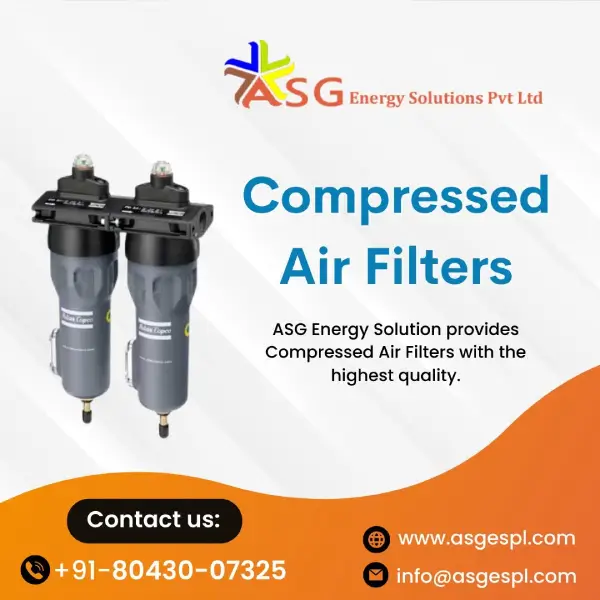
Compressed Air Filter in Bangalore

Compressed Air Filter in Bangalore — Complete Guide to Industrial Air Filtration, Selection and Service in 2026

A compressed air filter is not an accessory — it is the primary defence between the contaminated air that leaves your compressor and the clean, dry, oil-free air that your processes, instruments, and products require.

Without correctly specified and maintained filtration, even a high-quality rotary screw compressor will deliver air laden with water aerosols, oil mist, pipe scale, and atmospheric dust — causing premature equipment failure, product contamination, and regulatory non-compliance across Bangalore’s diverse industrial base.

Whether your facility is in Peenya, Rajajinagar, Bommasandra, or Whitefield, understanding the types, grades, and correct selection of compressed air filters is essential for protecting your compressed air investment and the downstream processes that depend on it.

Compressed Air Filter in Bangalore

1. Why Compressed Air Filtration Matters — The Cost of Getting It Wrong

Contamination Is Inherent to Every Compressed Air System

Every litre of atmospheric air drawn into a compressor inlet carries with it water vapour, atmospheric dust, hydrocarbon vapour from the ambient environment, and micro-organisms — all of which are concentrated by the compression process and delivered downstream at elevated temperature and pressure.

An oil-injected screw compressor adds lubricant aerosols and oil vapour to this contaminant load; the downstream distribution network adds pipe rust, scale, and condensed water from poorly insulated or aged pipework; and the pressure cycling of load/unload operation repeatedly agitates settled debris into the active airstream.

The cumulative effect, in an unfiltered or under-filtered compressed air system, is a corrosive, oil-laden, particulate-rich fluid that degrades every piece of downstream equipment it contacts — from solenoid valves and air cylinders to spray guns, precision instruments, and pneumatic control panels.

The Business Cost of Inadequate Filtration

Solenoid valves contaminated with oil and particulate fail at a rate three to five times higher than those supplied with clean, filtered air — a maintenance cost multiplier that accumulates rapidly in automation-intensive facilities with hundreds of valve actuations per shift.

Compressed air tools in Peenya’s engineering shops and Yeshwanthpur’s automotive workshops suffer significantly accelerated bearing and seal wear when oil-contaminated air carries abrasive particulate into the lubrication pathways, reducing tool service life by 40-60% compared to properly filtered installations.

At the extreme end, unfiltered compressed air reaching food, beverage, or pharmaceutical product contact points creates contamination incidents that trigger product recalls — the cost of which far exceeds the lifetime expenditure on a complete compressed air filtration system.


2. What Contaminants Does a Compressed Air Filter Remove?

The Five Principal Compressed Air Contaminants

Solid particulate — including atmospheric dust ingested at the compressor inlet, rust and pipe scale from distribution pipework, and wear debris from compressor internals — ranges in size from large visible particles down to sub-micron aerosols, and causes abrasion damage in pneumatic equipment and blockage of precision orifices.

Liquid water — condensed from water vapour carried in the inlet air as it cools through the distribution system — collects in pipework low points, causes corrosion of steel components, promotes microbial growth in food-sensitive environments, and causes water hammer damage in pneumatic cylinders.

Water vapour — the gaseous phase of moisture that passes through liquid separators and coalescing filters — requires desiccant or refrigerant drying to remove, but downstream particulate filters must be capable of operating at the dew point delivered by the upstream dryer without performance degradation.


Oil and Oil Vapour — The Most Damaging Contaminants

Liquid oil aerosols and mist — carried from the oil separator of an oil-injected screw compressor at concentrations up to 10 mg/m3 before filtration — coat the internal surfaces of distribution pipework, accumulate in condensate traps, contaminate downstream equipment, and render compressed air unsuitable for food, pharmaceutical, and precision manufacturing applications.

Oil vapour — the gaseous hydrocarbon fraction that passes through coalescing filters unimpeded — is invisible, odourless at low concentrations, and immeasurable without specialist instrumentation, yet causes taste and odour contamination of food products, catalyst poisoning in chemical processes, and adhesion failure in surface treatment applications.

Micro-organisms — bacteria, yeasts, and moulds drawn in with atmospheric air or resident in water-contaminated distribution pipework — represent a contamination risk in food, beverage, pharmaceutical, and medical device manufacturing environments that requires sterile-grade filtration (0.2 micron) at critical point-of-use locations.


3. Types of Compressed Air Filters — A Technical Guide

General Purpose Pre-Filters (Bulk Liquid and Coarse Particulate)

General purpose pre-filters, also designated Grade A in Atlas Copco’s filter classification, are the first stage of any multi-stage compressed air filtration train, removing bulk liquid water and oil droplets, large particulate down to 3 microns, and coarse aerosols that would otherwise rapidly saturate and damage the more expensive high-efficiency filters downstream.

They operate through a combination of centrifugal separation, impingement on filter media, and gravity drainage of coalesced liquid to the automatic float drain at the filter base — handling the high contamination burden immediately downstream of the aftercooler and before the refrigerant dryer.

Correctly specifying a general purpose pre-filter upstream of every high-efficiency coalescing filter is critical: without pre-filtration, the fine-glass-fibre media of a coalescing filter rapidly saturates with bulk liquid, increases pressure drop across the filter train, and fails prematurely — multiplying element replacement costs.


High-Efficiency Coalescing Filters (Oil Aerosol and Fine Particulate Removal)

Coalescing filters are the workhorse of compressed air filtration, using borosilicate glass microfibre media at element grades from 1 micron (Grade B, achieving less than 0.1 mg/m3 residual oil) to 0.01 micron (Grade C, achieving less than 0.01 mg/m3 residual oil) to capture sub-micron oil aerosols and fine solid particulates.

The coalescing mechanism works by forcing the compressed air through the microfibre depth-filtration media, where aerosol droplets collide with fibres and coalesce into progressively larger droplets that drain under gravity to the filter sump for automatic discharge — a process that continues effectively without the pressure drop increase associated with particulate cake filtration.

High-efficiency coalescing filters at Grade C output achieve ISO 8573-1 Class 1 oil purity (less than 0.01 mg/m3) — sufficient for most industrial, automotive, and general manufacturing applications in Bangalore’s Peenya and Rajajinagar corridors, and adequate for many indirect food contact applications.


Activated Carbon Filters (Oil Vapour and Odour Removal)

Activated carbon filters, designated Grade D in Atlas Copco’s system, address the hydrocarbon vapour fraction that passes through coalescing filters unchanged — reducing total oil content including vapour to below 0.003 mg/m3, which is undetectable by human smell and meets the most stringent food and pharmaceutical process air specifications.

The adsorption mechanism relies on the vast internal surface area of activated carbon granules — up to 1,000 m2 per gram — to trap hydrocarbon molecules as compressed air passes through the carbon bed; the bed capacity is finite and exhausts over time, making carbon filter element replacement on a strict time-based schedule (typically every 6-12 months) non-negotiable regardless of pressure drop indicators.

Activated carbon filters must always be installed downstream of a high-efficiency coalescing filter — bulk oil aerosol upstream of the carbon bed rapidly saturates the carbon pores with liquid oil, destroying adsorption capacity for vapour and cutting service life from months to weeks.


Dust Filters (Downstream Particulate Protection)

Downstream dust filters, also called sterile or particulate retention filters, are installed immediately after the activated carbon filter to capture carbon dust and activated carbon fines that can be released from the carbon bed — fines that would contaminate downstream instruments, product contact surfaces, and pneumatic equipment if uncontrolled.

They also serve as the final particulate barrier before point-of-use, capturing any debris released by distribution system disturbances — valve chattering, pressure surges, or pipework movement — that can mobilise settled contamination in aged distribution networks.

In pharmaceutical, food, and electronics manufacturing applications, sterile-grade dust filters with 0.2 micron absolute filtration ratings provide bacteriostatic air quality compliant with ISO 8573-7 Class 1 microbiological requirements.


4. Compressed Air Filter Types — Quick Reference

The following table summarises the four principal compressed air filter types, their performance characteristics, and their role in a correctly sequenced filtration train:


Filter Type

Grade

Removal Rating

Residual Oil

Position in Train

Key Application

General Purpose Pre-Filter

A

> 3 micron particles, bulk liquid

> 1 mg/m3

First stage

All systems: protects downstream filters

High-Efficiency Coalescing

B

> 0.1 micron, aerosol and mist

< 0.1 mg/m3

After pre-filter

General industry, automation

High-Efficiency Coalescing

C

> 0.01 micron, sub-micron aerosol

< 0.01 mg/m3

After Grade B

Precision instruments, near-food contact

Activated Carbon

D

Oil vapour and odour

< 0.003 mg/m3

After Grade C coalescing

Food, beverage, pharmaceutical, paint

Dust / Sterile Particulate

E

> 0.2 micron, carbon fines

None added

Final stage

Food, pharma, electronics


Not every application requires all five stages — a standard industrial automation system may require only Grade A and Grade B, while a food-contact application requires the full A-B-C-D-E train.

The correct sequence is always pre-filter first, coalescing next, carbon after, and dust/sterile last — reversing or omitting stages in this sequence dramatically reduces the effectiveness of every filter in the train.


5. ISO 8573-1 Filter Grade Selection — Matching Filtration to Your Application

How ISO 8573-1 Drives Filter Specification

The ISO 8573-1:2010 compressed air purity classification system assigns a quality class number to each contaminant category — particles, water, and oil — based on maximum permissible concentration, and these class numbers directly determine which filter grades are required in the system.

A facility requiring ISO 8573-1 Class 2 oil purity (less than 0.1 mg/m3) needs a minimum of Grade A and Grade B filtration downstream of the compressor; a facility requiring Class 1 (less than 0.01 mg/m3) needs Grade A, B, and C; and Class 0 compliance at oil-free quality requires Grade A, C, and D as a minimum downstream treatment train.

The filter grade selection table below provides a practical mapping from application type to the required filtration train for Bangalore’s industrial buyers:


Application

Required ISO 8573-1 Class (Oil)

Minimum Filter Train Required

Atlas Copco Filter Grades

General workshop pneumatics

Class 3 (< 1 mg/m3)

General purpose pre-filter only

DD

Automation, valves, cylinders

Class 2 (< 0.1 mg/m3)

Pre-filter + coalescing (Grade B)

DD + PD

Precision instruments, spray painting

Class 1 (< 0.01 mg/m3)

Pre-filter + coalescing A + coalescing B

DD + PD + PD fine

Indirect food / beverage contact

Class 1 (< 0.01 mg/m3)

Pre-filter + Grade C coalescing

DD + PD

Direct food contact, packaging

Class 0 (< 0.01 mg/m3)

Full train: Grade A-B-C-D-E

DD + PD + DDp + QD

Pharmaceutical process air

Class 0 + microbial

Full train + sterile filter

DD + PD + DDp + QD + sterile

Paint spray booths

Class 1 + oil vapour

Grade A + C coalescing + activated carbon

DD + PD + DDp


This table is a reference guide; specific system design must account for actual flow rates, inlet contamination levels, and downstream equipment sensitivity — all of which are addressed in a site survey by ASG Energy Solutions’ technical team.


6. Compressed Air Filtration System Design — Getting the Architecture Right

Filter Train Sequence and System Layout

A correctly designed compressed air filtration train follows a defined sequence from the compressor discharge: aftercooler, moisture separator, refrigerant dryer, general purpose pre-filter, high-efficiency coalescing filter, activated carbon filter (where required), and point-of-use dust filter — with automatic condensate drains on every liquid-collection stage.

The refrigerant dryer is positioned before the coalescing filter train in most installations, because the dryer reduces the moisture load presented to the coalescing media, extending element life and reducing the risk of moisture flooding the filter sump in high-humidity conditions such as Bangalore’s monsoon season.

In systems where oil-free air is required for critical applications while other areas of the plant use standard quality air, a zoned distribution design — with the critical filtration train serving only the high-purity zone — is more economical than treating the entire compressed air output to Class 0 standards.


Pressure Drop — The Hidden Energy Cost of Filtration

Every compressed air filter introduces a pressure drop across the filter element — typically 0.1 to 0.3 bar for a clean, correctly sized element — which means the compressor must run at a proportionally higher discharge pressure to compensate, consuming additional energy at a rate of approximately 6-8% per bar of additional pressure.

A blocked or overdue-for-replacement filter element can create a pressure drop of 0.5 to over 1.0 bar — forcing the compressor to run 6-16% harder simply to overcome the filtration resistance, wasting energy and adding heat stress to both the compressor and the filter housing.

Differential pressure (delta P) indicators fitted to every filter housing — displaying a red warning flag when the element pressure drop exceeds the replacement threshold — are the essential monitoring tool for maintaining filtration efficiency without unnecessary energy consumption.


Automatic Condensate Drains — Preventing Filter Flooding

Every filter housing that collects liquid must be fitted with an automatic condensate drain — either a float-type zero-loss drain or an electronic timer-based drain — to ensure that accumulated condensate is expelled from the system before it re-enters the clean air stream.

Manual drain valves are inadequate in production environments: they are routinely overlooked during shift operations, and the consequence of an overlooked flooded filter sump is liquid carry-over into downstream equipment — undoing the entire purpose of the filtration system.

Zero-loss automatic drains, which only open when condensate is present, are superior to timer-based drains that exhaust compressed air on a fixed schedule regardless of whether liquid has accumulated — a distinction that is particularly relevant in Bangalore’s variable humidity climate where condensate volumes change dramatically between dry and monsoon seasons.


7. Compressed Air Filter Sizing — Avoiding Undersizing and Oversizing

Why Filter Sizing Matters as Much as Filter Selection

A compressed air filter sized for a flow rate lower than the actual system demand operates with excessive face velocity through the filter media, increasing pressure drop, reducing filtration efficiency (as aerosols are swept through at high velocity without time for coalescing), and dramatically shortening element service life.

Conversely, an oversized filter operates at very low face velocity, which reduces the kinetic energy available for aerosol impaction in coalescing media and can actually worsen filtration efficiency for sub-micron oil aerosols at very low flow fractions of rated capacity — a counter-intuitive behaviour specific to depth-filtration coalescing media.

Correct filter sizing specifies the rated flow at the operating pressure and temperature, with a capacity margin of 10-20% above the maximum system flow — neither undersized nor grossly oversized — to deliver both the performance and service life the filter manufacturer has validated the design to achieve.


The Effect of Operating Pressure on Filter Rating

All filter flow ratings are declared at a reference pressure — typically 7 bar gauge — and must be corrected for the actual operating pressure of the system using the manufacturer’s published correction factors.

A filter rated at 100 m3/min (FAD) at 7 bar delivers a different volume flow at 4 bar or 10 bar operating pressure, and specifying filters based on nameplate capacity alone without pressure correction is a common and costly error that leads to undersizing, elevated pressure drop, and premature element failure.

ASG Energy Solutions’ filter selection process always corrects for actual system operating pressure, temperature, and inlet contamination level — the three variables that together determine the true sizing requirement for any compressed air filter installation in Bangalore.


8. Compressed Air Filter Maintenance — Elements, Intervals, and Best Practice

When to Replace Filter Elements

Compressed air filter elements should be replaced on whichever of two criteria arrives first: the differential pressure indicator reading (replacing the element when the delta P flag turns red, indicating the pressure drop across the element has reached the replacement threshold), or the manufacturer’s maximum service interval regardless of pressure drop reading.

For coalescing filter elements, the maximum service interval is typically 8,000-12,000 hours or one year, whichever comes first — because the glass microfibre media degrades over time through compressive cycling, chemical attack from oil degradation products, and microbiological colonisation in humid systems, even when the pressure drop indicator has not triggered.

For activated carbon filter elements, time-based replacement is mandatory: the delta P indicator does not reflect carbon bed exhaustion, which occurs silently at the molecular adsorption level — a fully exhausted carbon filter passes oil vapour freely while showing zero pressure drop, providing no visible warning until oil vapour reaches the downstream process.


Service Interval Guide for Bangalore’s Climate

Bangalore’s monsoon season — June through September — presents the highest moisture challenge for compressed air filter systems, as elevated inlet humidity dramatically increases the volume of condensate that filter sumps must handle and accelerates the saturation rate of coalescing media.

Pre-monsoon inspection and replacement of all filter elements in May, combined with cleaning of all automatic drain valves, ensures the filtration system enters the peak condensate season in optimal condition — preventing the moisture carry-over failures that occur when filters loaded from the previous monsoon are carried over into another high-humidity cycle.

Similarly, Bangalore’s April-June high-temperature period increases the oil vapour partial pressure in compressed air from oil-injected compressors, loading activated carbon filters at a higher rate than winter months — making October-November the correct time for annual carbon filter replacement in the Bangalore climate cycle.


OEM vs Aftermarket Filter Elements — The Compromise You Cannot Afford

Aftermarket filter elements are available at prices 30-50% below OEM equivalents and are widely sold in Bangalore’s industrial supply market — but the apparent saving is systematically eliminated by the performance shortfalls they introduce.

OEM coalescing elements are manufactured to precise media density, pore size distribution, and end-cap tolerances that together produce the validated filtration efficiency claimed on the filter housing data plate; aftermarket elements with looser manufacturing tolerances pass higher levels of oil aerosol, defeating the purpose of the Grade B or Grade C filter specification.

Using genuine Atlas Copco OEM filter elements — available from ASG Energy Solutions at Ashwathnagar — is the only way to ensure the filtration system delivers the ISO 8573-1 purity class it was designed and specified to achieve, maintaining downstream equipment protection and regulatory compliance without compromise.


9. The Cost of Neglecting Compressed Air Filtration — A 5-Year Comparison

Deferred filter maintenance creates a cascade of downstream costs that invariably exceed the savings from extended element change intervals.

The table below compares the 5-year cost profile of a maintained versus a neglected compressed air filtration system for a typical 37 kW screw compressor installation in Bangalore:


Cost Component

Maintained Filtration System

Neglected Filtration System

Annual filter element cost

Rs 45,000

Rs 15,000

Additional energy cost (elevated delta P)

Negligible

Rs 1,20,000/yr

5-Year energy overspend

Rs 6,00,000

Solenoid valve replacement (accelerated failure)

Rs 40,000 (5 yr)

Rs 1,80,000 (5 yr)

Pneumatic cylinder seal replacement

Rs 25,000 (5 yr)

Rs 1,10,000 (5 yr)

Compressed air tool replacement

Rs 30,000 (5 yr)

Rs 1,50,000 (5 yr)

Unplanned downtime (estimated, 5 yr)

Rs 50,000

Rs 4,50,000

Product contamination / compliance cost

Negligible

Rs 5,00,000+

5-Year Total Cost

Rs 3,90,000

Rs 22,05,000+

Saving from maintained filtration (5 yr)

Rs 18,15,000+


All figures are illustrative estimates based on industry cost benchmarks. Actual costs vary by facility size, production criticality, and energy tariff.

The maintained filtration system costs Rs 45,000 more in filter elements per year — and saves an estimated Rs 18 lakhs over five years in downstream equipment protection, energy efficiency, and avoided contamination events.


10. Atlas Copco Compressed Air Filter Range — Available from ASG Energy Solutions in Bangalore

DD Series — General Purpose Pre-Filters

The Atlas Copco DD series general purpose pre-filters remove bulk liquid water and oil, and solid particulate down to 3 microns, from compressed air flows ranging from 20 to 20,000 l/min, at operating pressures from 2.5 to 16 bar gauge.

DD filters are designed for installation immediately downstream of the aftercooler and moisture separator, upstream of any refrigerant dryer, and as the mandatory first stage before any high-efficiency coalescing filter — handling the high liquid and particulate burden that would otherwise saturate fine-media coalescing elements within hours.

All Atlas Copco DD series housings include an integral automatic float drain, a visual contamination indicator, and a differential pressure indicator — giving maintenance teams at Bangalore’s manufacturing facilities a clear, visible service signal at every filter station.


PD Series — High-Efficiency Coalescing Filters

The Atlas Copco PD series high-efficiency coalescing filters achieve ISO 8573-1 Class 1 oil purity (less than 0.01 mg/m3 total oil aerosol) using a multi-layer borosilicate glass microfibre element, covering the same flow and pressure range as the DD series and sharing housing designs for modular multi-stage filter station assembly.

PD series elements carry independent performance certification and deliver consistent Grade C filtration performance across the published flow range when correctly sized — providing Bangalore’s industrial buyers with the documented purity evidence needed for customer, regulatory, and food safety audit programmes.

The PD series is the filtration product of choice for precision manufacturing facilities in Bangalore’s Whitefield and Electronic City corridors, automotive paint shops in Bommasandra, and food-adjacent pneumatic systems requiring Class 1 oil purity throughout the production area.


DDp Series — Activated Carbon Filters and QD Dust Retention Filters

The Atlas Copco DDp series activated carbon adsorption filters reduce total oil content including vapour to below 0.003 mg/m3 — meeting the most stringent food, beverage, and pharmaceutical process air specifications — using a replaceable activated carbon cartridge designed for straightforward annual element exchange.

The Atlas Copco QD series downstream dust filters capture activated carbon fines and any residual particulate from the treatment train upstream, delivering ISO 8573-1 Class 1 particle quality at the point of use — the final safeguard before compressed air reaches product contact equipment.

ASG Energy Solutions stocks DD, PD, DDp, and QD series filter elements for all common flow sizes at their Ashwathnagar Bangalore location, enabling same-day supply for most standard element replacement requirements — eliminating the lead time risk associated with ordering elements from distributors outside Karnataka.


11. Industry-Specific Compressed Air Filter Selection Guide for Bangalore

Manufacturing, Fabrication, and Engineering

Metal fabrication units in Peenya, Rajajinagar, and Yeshwanthpur typically require compressed air filtered to Grade A-B (ISO 8573-1 Class 2 oil, Class 3 particles) for general pneumatic tools, automation, and material handling — a two-stage DD-plus-PD installation that addresses the contamination risks specific to oil-injected screw compressor systems.

Welding and plasma cutting systems require clean, dry air — moisture in cutting air causes arc instability and weld porosity, while oil contamination in welding purge gas causes fusion defects and failed weld inspection — making a Grade B-C installation with a refrigerant dryer mandatory for quality-critical metalwork applications.

CNC machining centres with air bearing spindles and pneumatic tool changers are among the most contamination-sensitive applications in Bangalore’s precision engineering sector: these systems require Grade C coalescing and Grade D carbon filtration to prevent oil deposits on air bearings from causing catastrophic spindle failure.


Automotive, Textiles, and Surface Treatment

Automotive paint spray booths in Bommasandra and Bidadi require compressed air filtered to Grade A-C (ISO 8573-1 Class 1 oil) as a minimum, with Grade D activated carbon filtration where oil vapour-free air is specified by the paint system manufacturer — oil vapour contamination in spray air causes fish-eye defects, adhesion failures, and surface finish rejection.

Textile machinery at Peenya and Yelahanka — including air-jet looms, yarn tensioning systems, and fabric brushing equipment — requires Grade B compressed air free from liquid oil that would stain or contaminate fabric in process, with particular attention to filter maintenance in the high-humidity monsoon season when liquid carryover risk peaks.

Industrial surface treatment operations including abrasive blasting, thermal spray coating, and powder coating all require dry, clean compressed air at Grade B-C — water in blasting air causes media clumping and uneven finish, while oil contamination in thermal spray gas contaminates the coating adhesion surface.


12. Why ASG Energy Solutions Is Bangalore’s Most Trusted Compressed Air Filter Dealer

23+ Years of Compressed Air System Expertise

ASG Energy Solutions has served Bangalore’s industrial sector as an authorised Atlas Copco dealer since 2002, accumulating over two decades of compressed air filtration project experience across manufacturing, automotive, food and beverage, pharmaceutical, and engineering sectors throughout Karnataka.

Their technical team does not simply supply filter housings and elements — they conduct compressed air contamination assessments, specify the correct filter train for each application’s ISO 8573-1 quality requirement, design the filter station layout, and commission the installation with performance verification testing.

For third-party audit programmes, food safety certification, and export compliance requirements, ASG Energy Solutions provides system documentation — including filter data sheets, element batch traceability, installation records, and service history — in a format directly usable in FSSAI, BRC, FSSC 22000, and customer audit submissions.


Genuine Atlas Copco Filter Elements — Stocked in Bangalore

ASG Energy Solutions maintains stock of genuine Atlas Copco OEM filter elements for DD, PD, DDp, and QD series housings at their Ashwathnagar location, covering the most common flow sizes used in Bangalore’s industrial and food processing sectors.

Genuine OEM elements provide the only assurance that the installed filter system delivers the ISO 8573-1 purity class stamped on the housing data plate — because only OEM elements are manufactured to the media specification, end-cap tolerance, and bypass seal standard that the housing and system were validated to.

Same-day element supply from local stock means that a red differential pressure indicator at a Bangalore facility translates to an element change the same day — not a week-long wait for delivery from outside Karnataka that forces the facility to run with a contaminated, high-pressure-drop filter train.


Service Coverage Across Bangalore’s Industrial Corridors

From their Ashwathnagar base, ASG Energy Solutions’ compressed air service team covers all of Bangalore’s industrial corridors — Peenya, Rajajinagar, Yeshwanthpur, Bommasandra, Bidadi, Electronic City, Whitefield, Doddaballapur, Yelahanka, and the Tumkur Road industrial corridor — with rapid on-site response for both planned service and emergency call-outs.

Their preventive maintenance programmes for compressed air filtration systems cover scheduled element replacement, drain valve inspection and cleaning, differential pressure indicator calibration check, and system contamination level spot-testing — providing a complete, documented filtration maintenance record that satisfies audit requirements without internal resource burden.

For facilities with multiple compressor installations — such as large-scale food processing parks at Hoskote or automotive supplier clusters at Neelamangala — ASG Energy Solutions manages consolidated filter element schedules, ensuring every station in the system is serviced on time regardless of the complexity of the multi-compressor layout.


Frequently Asked Questions About Compressed Air Filters

FAQ 1: What types of compressed air filters are available?

The four principal types are: general purpose pre-filters (removing bulk liquid and particles above 3 microns), high-efficiency coalescing filters (removing oil aerosols and fine particulate to 0.01 microns), activated carbon adsorption filters (removing oil vapour and odour), and downstream dust/sterile filters (capturing carbon fines and providing bacteriostatic protection).

A complete filtration train uses all four types in sequence: pre-filter first, high-efficiency coalescing second, activated carbon third (where required), and dust filter last.

ASG Energy Solutions stocks the full Atlas Copco DD, PD, DDp, and QD filter range in Bangalore, covering all four types for flow rates from 20 l/min to over 10,000 l/min.


FAQ 2: How often should compressed air filter elements be replaced?

High-efficiency coalescing elements should be replaced when the differential pressure indicator triggers, or annually — whichever comes first.

Activated carbon elements must be replaced on a strictly time-based schedule (typically every 6-12 months regardless of pressure drop readings), because carbon bed exhaustion is invisible to pressure drop monitoring.

In Bangalore’s high-humidity monsoon environment, pre-monsoon element replacement in May is strongly advisable to ensure the filtration system enters the peak condensate season with full capacity.


FAQ 3: What is the difference between a coalescing filter and an activated carbon filter?

A coalescing filter removes liquid oil aerosols and fine solid particulate from the compressed airstream by physically capturing them in glass microfibre media — it is effective for oil in liquid and aerosol form, but allows oil vapour to pass through.

An activated carbon filter addresses the vapour phase — adsorbing gaseous hydrocarbons, amine-based compressor fluid vapour, and odour-causing compounds onto the internal surface of activated carbon granules.

Both are required in any application demanding ISO 8573-1 Class 0 oil purity, and activated carbon filters must always be installed downstream of a coalescing filter to prevent liquid oil from flooding the carbon bed.


FAQ 4: Can I use aftermarket filter elements in Atlas Copco filter housings?

Aftermarket elements can be physically fitted to Atlas Copco housings, but doing so voids the manufacturer’s performance certification for the housing — meaning the stated ISO 8573-1 purity class for that filter station is no longer guaranteed or documentable.

For general industrial applications where air purity is not audit-critical, the risk may be accepted with the understanding that actual filtration efficiency is unverified; for food, pharmaceutical, and export-compliance applications, only OEM elements maintain the documented purity guarantee required by audit bodies.

ASG Energy Solutions supplies genuine Atlas Copco OEM elements from local Bangalore stock and can advise on the correct element references for any housing in the range.


FAQ 5: How do I know when a compressed air filter element needs replacing?

The primary indicator is the differential pressure gauge or flag indicator fitted to the filter housing — when the flag turns red or the pressure drop exceeds the replacement threshold (typically 0.5-0.7 bar), the element is due for change.

For activated carbon filters, time-based replacement on a fixed schedule (6-12 months) is mandatory, regardless of the pressure drop reading, because carbon exhaustion occurs without any change in pressure drop.

Additionally, compressed air system performance issues — unexplained equipment failures, oil odour downstream, increased tool wear, or visible moisture downstream of the dryer — can indicate filter system problems requiring immediate inspection, even when no pressure drop alarm has triggered.


FAQ 6: What compressed air filter grade do I need for my Bangalore factory?

The correct filter grade depends on your application: general pneumatic tools and conveyors require Grade A-B (ISO 8573-1 Class 2 oil); precision instruments, CNC systems, and spray painting require Grade A-B-C (Class 1 oil); food contact and pharmaceutical applications require the full Grade A-B-C-D-E train (Class 0 oil).

ASG Energy Solutions conducts free compressed air contamination assessments and filter specification reviews for Bangalore facilities — ensuring the correct filter grade is specified for each application without over-specifying where simpler filtration is sufficient.

Contact ASG Energy Solutions at Ashwathnagar, Bangalore for a no-obligation filter selection consultation tailored to your facility’s specific requirements.


FAQ 7: Why does compressed air filter price vary so much in Bangalore?

Compressed air filter prices vary based on flow capacity, filtration grade, housing construction (aluminium vs stainless steel for food-grade applications), certification level (standard vs ATEX for hazardous area), and whether the price is for a housing alone, elements alone, or a complete station.

Genuine OEM filter elements from authorised dealers like ASG Energy Solutions carry a price premium over aftermarket equivalents that reflects validated performance, batch traceability, and warranty support — not inflated margin.

The lowest-price compressed air filter option invariably represents the highest total cost when downstream equipment damage, product contamination risk, and compliance exposure are factored into the decision.


Get the Right Compressed Air Filter for Your Bangalore Facility

Compressed air filtration is one of the highest-return maintenance investments available to any industrial facility — protecting capital equipment, reducing energy costs, preventing product contamination, and sustaining regulatory compliance for a fraction of the cost it saves.

ASG Energy Solutions has been supplying, designing, and maintaining compressed air filtration systems across Bangalore’s industrial corridors for over 23 years as an authorised Atlas Copco dealer — with genuine OEM elements in local stock and a technical team that specifies correctly rather than simply selling the nearest catalogue item.


Contact ASG Energy Solutions at their Ashwathnagar, Bangalore service centre today for:


  • Free compressed air contamination assessment and ISO 8573-1 filter grade specification
  • Genuine Atlas Copco DD, PD, DDp and QD filter element supply from local Bangalore stock
  • Complete filter station design, supply, and installation with commissioning documentation
  • Preventive maintenance programmes with scheduled element replacement and audit-ready records
  • Emergency same-day element supply for urgent filter replacement requirements


Their compressed air service team covers Peenya, Rajajinagar, Bommasandra, Whitefield, Bidadi, Electronic City, Yeshwanthpur, Doddaballapur, and all of Bangalore’s industrial zones.

Stop paying the hidden cost of inadequate filtration — call ASG Energy Solutions, Bangalore’s trusted compressed air filter specialist since 2002.

Contact Us Today

Looking for reliable industrial energy solutions? Reach out to ASG Energy Solutions Pvt. Ltd. for expert guidance, tailored project support, and top-quality products that drive performance and efficiency. Whether you need advanced air compressors, leak detection systems, or custom maintenance services, our team is ready to assist you. We prioritize your business needs with fast response times, professional service, and long-term support. Get in touch today and discover how we can power your operations with confidence.

0385f96c object 15
bab5983a image11
86ea0706 object 16
bdf2ad54 object 17
Enquiry Form

© 2026 ASG Energy Solutions Pvt Ltd | All Rights Reserved | Website Developed by EchoPx.com

Send Enquiry

Enquiry Form