Reliable compressed air supply
Industrial air compressors provide compressed air for production equipment requiring consistent operating pressure and adequate delivery capacity.

Atlas Copco Authorized Partner · Since 2002
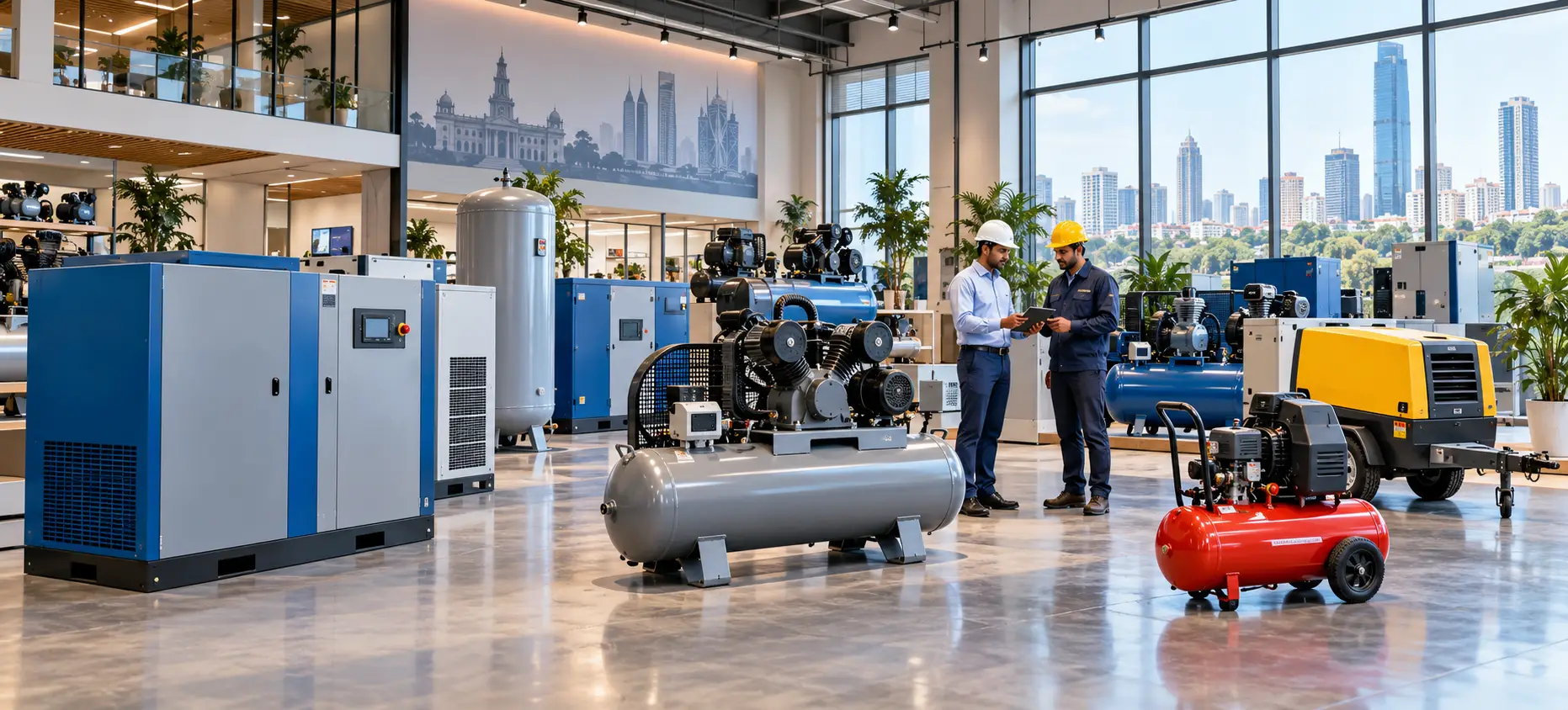
Industrial Air Compressors, Rotary Screw Compressors and Complete Compressed Air Solutions from ASG Energy Solutions
Request an Industrial Air Compressor Quote
Share your application, required air delivery, working pressure, annual operating hours, air quality requirements and installation location.
An industrial air compressor is an essential part of modern manufacturing, providing a reliable source of compressed air for production equipment, pneumatic machinery, industrial processes, material handling, packaging systems, and other factory operations. From automotive manufacturing and pharmaceutical production to cement plants, food processing facilities, metalworking industries, and heavy engineering units, compressed air plays a critical role in maintaining productivity, operational efficiency, and uninterrupted industrial performance.
Choosing the right industrial air compressor machine is important for achieving consistent air pressure, dependable performance, energy efficiency, and reduced operating costs. An incorrectly sized or poorly maintained compressor can increase electricity consumption, create pressure fluctuations, affect production quality, and result in unexpected downtime.
ASG Energy Solutions Pvt. Ltd. (ASGESPL) provides industrial air compressor systems, compressed air treatment equipment, industrial utility piping, energy audits, and compressor maintenance solutions for manufacturing and process industries across India.
Established in 2002 and based in Bangalore, ASGESPL is an authorized Atlas Copco partner, supplying and servicing industrial compressed air equipment designed to meet different production requirements.
Our compressed air solutions include rotary screw compressors, oil-injected compressors, oil-free air compressors, reciprocating compressors, centrifugal compressors, industrial gas compressors, compressed air dryers, air filters, air receivers, and associated compressed air system components.
Whether your facility requires a new industrial air compressor, expansion of an existing compressor installation, energy-efficient replacement equipment, or maintenance support for an operating compressed air network, ASGESPL helps identify suitable solutions based on actual air demand, operating pressure, air quality requirements, production schedules, and long-term operating costs.
Looking for an industrial air compressor in India? Contact ASGESPL for compressor selection, system evaluation, product information, and a quotation.
Get Free QuoteAn industrial air compressor is a mechanical machine that converts mechanical energy into compressed air by increasing the pressure of atmospheric air. The compressed air is stored or supplied directly to production equipment and industrial processes requiring a dependable source of pneumatic power.
Unlike small air compressors intended for occasional use, an industrial compressor machine is selected for the operating demands of manufacturing facilities, where equipment may be required to function continuously or repeatedly across several production shifts.
Industrial compressed air systems support a variety of applications, including pneumatic actuators, manufacturing machinery, automated production equipment, industrial instrumentation, packaging machines, material conveying equipment, and plant utility operations.
The performance of an industrial air compressor depends on several factors, including compressor technology, motor capacity, air delivery, working pressure, duty cycle, operating temperature, control system, and air treatment requirements.
A properly engineered compressed air system considers not only the compressor but also the complete network of equipment that supplies clean, dry, and reliable compressed air to the required point of use.
This may include compressed air receivers, refrigerant air dryers, desiccant dryers, filtration systems, condensate management equipment, distribution piping, monitoring systems, and appropriate compressor controls.
At ASGESPL, compressor selection begins with understanding the industrial application rather than recommending machinery based only on motor horsepower or purchase price.
For an air compressor for industry, reliability over long operating hours matters as much as rated output, and a heavy duty air compressor should be selected against the real duty cycle, working pressure, air quality and energy use of the plant.
Condensate management, monitoring systems and compressor controls support the complete network.
Industrial manufacturing depends on predictable production performance. Compressed air supply must therefore be capable of supporting the operational requirements of the production line without excessive energy consumption or unnecessary interruptions.
A correctly selected industrial air compressor helps maintain consistent working pressure and adequate airflow for connected equipment.
When choosing an air compressor for industrial use, factories must evaluate both normal operating conditions and changes in compressed air consumption throughout the production cycle.
Some manufacturing facilities have relatively stable air demand over long operating periods. Others experience frequent demand fluctuations caused by machine loading, batch production, changing shifts, or intermittent pneumatic equipment use.
A compressor operating efficiently under one demand pattern may not be the most economical solution for another.
ASGESPL supports industrial compressed air system planning through assessment of airflow, pressure requirements, production operating hours, and opportunities for improved energy performance.
Industrial air compressors provide compressed air for production equipment requiring consistent operating pressure and adequate delivery capacity.
A properly designed compressed air system helps pneumatic machinery and industrial processes operate according to production requirements.
Modern compressor technologies, including variable speed drive systems where appropriate, can help reduce unnecessary energy consumption.
Suitable equipment selection, preventive maintenance, and system monitoring help improve compressed air availability.
Compressed air can serve a wide range of manufacturing applications, including pneumatic automation, process control, packaging, and material handling.
Compressed air installations can be planned to accommodate production growth through appropriate compressor combinations, receivers, and distribution networks.
Proper sizing, leak management, pressure optimization, and maintenance help reduce the total cost of compressed air generation.
Different industrial applications require different compressor technologies. Selecting the appropriate compressor type depends on air consumption, pressure requirements, operating hours, air quality specifications, efficiency targets, and production conditions.
ASGESPL supplies and supports industrial compressed air equipment from Atlas Copco, including the following technologies.
A rotary screw air compressor is widely used in industrial manufacturing because it can provide a continuous supply of compressed air with stable performance.
Rotary screw compressors operate using rotating screw elements that compress air as the available volume decreases.
These compressors are commonly selected for manufacturing units that require dependable airflow over extended operating periods.
Industrial screw compressors are suitable for many applications involving pneumatic machinery, production equipment, assembly lines, packaging systems, and general factory compressed air requirements.
Rotary screw compressors are used in automotive component manufacturing, metal fabrication, engineering workshops, textile manufacturing, industrial packaging, woodworking, electronics manufacturing, and general industrial production.
ASGESPL provides access to Atlas Copco rotary screw compressor solutions, including selected GA series products.
Oil-injected rotary screw compressors use lubricating oil inside the compression process for cooling, lubrication, and sealing.
These compressors are widely used in industrial facilities where reliable compressed air is required and appropriate downstream air treatment can meet the application requirements.
Oil-injected industrial compressors are commonly found in manufacturing, machine operation, assembly, fabrication, and other industrial processes.
Oil separation, filtration, condensate treatment, and compressor maintenance are important aspects of these installations.
Oil-injected screw compressors offer a practical compressed air solution for many general industrial applications.
They are available in multiple configurations and can be integrated with air receivers, compressed air dryers, filtration equipment, and industrial distribution networks.
For applications sensitive to oil contamination, the required compressed air purity must be evaluated carefully. An oil-injected compressor should not be assumed to deliver oil-free air simply because filters are installed.
An oil-free industrial air compressor is used where compressed air purity is particularly important to production quality, process integrity, or contamination control.
Oil-free compression technology avoids introducing oil into the compression chamber, making it suitable for applications with stringent requirements regarding oil contamination.
Oil-free air compressors are particularly relevant to pharmaceutical manufacturing, food and beverage processing, electronics manufacturing, and selected critical industrial processes.
Certain Atlas Copco oil-free compressor configurations are available with Class 0 oil purity certification under ISO 8573-1. The exact air purity requirement and product certification should be checked for the selected equipment.
Oil-free compression does not automatically remove ambient particles, moisture, or other contaminants. A complete compressed air treatment system may still be required.
ASGESPL helps industrial customers assess the need for oil-free compressor technology in relation to application-specific air quality standards.
A variable speed drive air compressor adjusts compressor motor speed to help match compressed air production with changing demand.
Conventional fixed-speed compressors are suited to certain operating profiles, particularly where compressed air demand remains relatively consistent.
However, factories with fluctuating air consumption may benefit from the operating flexibility of VSD compressor technology.
A variable speed drive compressor can reduce unnecessary unloaded operating periods and improve energy performance when correctly applied.
Actual energy savings depend on measured demand profiles, compressor selection, system pressure, control strategy, and installation conditions.
ASGESPL supplies and services applicable Atlas Copco VSD compressor solutions, including GA series variable-speed technologies.
Piston compressors, also known as reciprocating compressors, use one or more pistons moving inside cylinders to compress air.
These compressors are commonly used in applications requiring intermittent compressed air supply or particular pressure and flow characteristics.
Depending on equipment design, reciprocating compressors may be available in single-stage or two-stage configurations.
When selecting a reciprocating air compressor, plant engineers should consider duty cycle, pressure requirements, capacity, operating hours, noise, maintenance, and air quality requirements.
Centrifugal compressors use dynamic compression technology to supply compressed air.
They are generally considered for applications requiring high-volume compressed air delivery and suitable operating conditions.
Centrifugal compressor technology may be relevant to larger industrial operations and centralized compressed air networks where demand characteristics support this type of equipment.
Typical application areas include major manufacturing facilities, process industries, and industrial installations with substantial compressed air requirements.
The suitability of centrifugal compression depends on the required capacity, working pressure, demand profile, system controls, and overall lifecycle cost.
Industrial gas compressors are used where a process requires compression of gases other than atmospheric air.
Gas compression systems must be selected according to the gas composition, pressure, temperature, process duty, material compatibility, and applicable safety requirements.
ASGESPL's industrial compressed air and gas solutions portfolio includes gas compressor technologies and related equipment for suitable industrial applications.
Gas handling requirements must be evaluated independently rather than treating all industrial gases as interchangeable with compressed air.
Portable industrial air compressors are designed for applications where compressed air is required at different work locations or temporary industrial operating points.
Mobile compressor technologies can support industrial projects, mining activities, infrastructure operations, and certain maintenance applications.
Depending on the equipment selected, mobile compressors may use electric or diesel power.
The appropriate compressor configuration depends on the operating environment, required airflow, pressure, site conditions, and available energy source.
ASGESPL's industrial compressor portfolio includes mobility compressor solutions for applicable industrial requirements.
Atlas Copco provides industrial compressed air technologies used in manufacturing and process industries.
As an authorized Atlas Copco partner, ASG Energy Solutions supplies and services suitable Atlas Copco compressed air equipment for industrial customers.
Our focus is to help industries select compressor configurations that suit their operating requirements while considering reliability, energy performance, maintainability, and total cost of ownership.
Atlas Copco GA rotary screw compressors are used in a wide range of industrial compressed air applications.
The product family includes fixed-speed and variable-speed technologies depending on the model.
The GA series is relevant for facilities requiring continuous compressed air supply for manufacturing machinery, production processes, pneumatic systems, and general industrial operations.
ASGESPL's compressor portfolio includes selected Atlas Copco GA configurations such as:
These rotary screw compressor models are suitable for consideration in industrial compressed air installations where their rated performance matches required demand.
Applications may include factory utility networks, production equipment, industrial machinery, and general manufacturing operations.
Atlas Copco GA variable-speed configurations can be considered for industrial plants with changing air demand.
Correct selection requires evaluation of the plant's measured consumption, operating pressure, annual running hours, and demand variations.
GA VSD+ compressors provide variable-speed compressed air technology for applicable industrial installations.
They can be evaluated for manufacturing facilities seeking to improve energy performance through demand-responsive compressor operation.
Atlas Copco variable-speed compressor technologies with interior permanent magnet motor configurations are also part of the applicable industrial compressor portfolio.
The appropriate model should be selected based on verified technical specifications and actual plant operating conditions.
ATC Automan compressor solutions are another option within the industrial compressed air equipment range for suitable applications.
Before selecting any specific compressor model, request current technical information covering flow capacity, working pressure, installed power, control type, air quality requirements, and installation conditions.
ASGESPL can assist with product selection and quotations for suitable Atlas Copco industrial compressor systems.
Get Free QuoteIndustrial compressed air requirements vary significantly between industries.
Some manufacturing operations prioritize uninterrupted airflow and long operating hours. Others require very clean compressed air, controlled moisture, stable pressure, or carefully managed contamination risks.
ASGESPL supports compressed air requirements across manufacturing and process industries by matching compressor technology, air treatment, and system engineering to the application.
Automotive manufacturing depends on compressed air for pneumatic actuators, production equipment, machine operation, component handling, and assembly processes.
Automotive component manufacturers require reliable compressed air delivery to support production schedules and consistent machinery performance.
Compressed air systems may be used throughout automotive and auto ancillary facilities, including component manufacturing, heavy-duty vehicle production, bus manufacturing, and electric vehicle component operations.
Air pressure stability, compressor reliability, and appropriate air quality are important when supplying multiple production machines from a shared compressed air network.
For automotive manufacturing plants with changing production demand, a correctly selected variable speed drive compressor may improve energy efficiency.
ASGESPL provides compressor systems, air treatment equipment, piping solutions, and compressed air energy assessments for suitable automotive industry applications.
Pharmaceutical manufacturing often requires carefully controlled compressed air quality.
Compressed air may be used in production equipment, pneumatic controls, packaging processes, instrumentation, and other manufacturing activities.
Where compressed air contacts the product or critical processing surfaces, contamination requirements can be especially stringent.
Oil-free compressors, appropriate drying technology, particulate filtration, and relevant air quality verification may be necessary depending on the process.
The air quality specification should consider particles, water, total oil, and any additional process-specific concerns.
ASGESPL provides oil-free compressed air solutions, compressed air dryers, filtration equipment, and system support suitable for selected pharmaceutical manufacturing requirements.
Food and beverage manufacturing requires reliable compressed air while managing potential contamination risks.
Compressed air may be used for packaging operations, pneumatic machinery, production equipment, conveying systems, and process controls.
Applications involving direct or indirect product contact may require especially careful compressed air purity management.
Oil-free compressor technology can be appropriate where process risk assessments call for stringent oil contamination control.
Refrigerant dryers, desiccant dryers, and suitable filters can support broader compressed air quality objectives.
ASGESPL helps food and beverage facilities evaluate compressors, air treatment equipment, and system efficiency based on their actual production requirements.
Cement plants operate in demanding environments where reliability and consistent compressed air delivery are important.
Compressed air supports pneumatic conveying, equipment operation, instrumentation, and several plant utility applications.
High operating hours, dust exposure, and demanding production schedules can influence compressor selection.
Suitable compressor capacity, intake air conditions, filtration, cooling, and preventive maintenance are particularly important.
ASGESPL provides industrial compressor systems and compressed air support solutions for suitable cement manufacturing applications.
Metalworking industries use compressed air for machine tools, pneumatic actuators, material handling equipment, production systems, and general factory processes.
Reliable pressure and proper moisture control support consistent machinery performance.
Depending on the manufacturing activity, facilities may require compressed air filtration, drying, and multiple pressure distribution points.
ASGESPL supports metalworking operations through compressor equipment, compressed air treatment, utility piping, and maintenance services.
Textile manufacturing facilities may require compressed air for production machinery, pneumatic equipment, machine controls, and selected processing operations.
Air demand can vary depending on machine operation, shift schedules, and production activity.
A correctly selected industrial screw compressor can support stable air supply.
Compressed air drying and filtration may also be necessary to protect equipment and maintain appropriate process conditions.
ASGESPL helps textile manufacturers evaluate their compressed air requirements and identify suitable systems.
Electronics manufacturing may involve sensitive equipment and production environments requiring controlled compressed air quality.
Moisture, particles, and oil contamination must be evaluated according to the specific application.
Oil-free compressor technologies, precision air treatment, and appropriate distribution systems may form part of the compressed air installation.
The exact cleanliness requirements depend on the process and should be defined before equipment selection.
ASGESPL supplies industrial compressed air technologies and associated treatment solutions for suitable electronics manufacturing applications.
Mining operations can require compressed air systems capable of functioning in difficult operating conditions.
Compressed air may be used for industrial equipment, pneumatic tools, instrumentation, and supporting plant processes.
Environmental conditions, duty cycle, equipment accessibility, and maintenance planning are important considerations.
Industrial screw compressors and mobility compressors may be appropriate depending on the application.
ASGESPL supports industrial compressor requirements through equipment selection and associated service solutions.
Railway equipment manufacturing and component production may use compressed air for assembly machinery, pneumatic tools, manufacturing equipment, and plant utilities.
Reliable compressor operation supports production continuity.
The right system depends on equipment requirements, operating pressure, air consumption, and working hours.
ASGESPL provides relevant industrial compressed air systems and supporting services for manufacturing facilities in the railway sector.
ASGESPL also supports suitable compressed air and industrial utility requirements in:
Each application requires an individual assessment of compressed air quantity, pressure, purity, reliability, and operating conditions.
Selecting the best industrial air compressor is not simply a matter of buying the largest compressor available.
The correct machine must deliver the required airflow at the required pressure, with suitable air quality, while operating efficiently under actual production conditions.
Oversizing a compressor can result in excessive investment and inefficient operation. Undersizing can lead to inadequate air supply, pressure fluctuations, and production problems.
Start by identifying the amount of compressed air consumed by connected equipment.
Air demand is normally expressed using flow units such as CFM or m³/min, with the reference conditions clearly defined.
The assessment should include continuous air consumption, intermittent equipment, simultaneous operation, and any expected future production changes.
Where possible, use measured plant demand rather than relying exclusively on equipment nameplate data.
Different pneumatic machines and industrial processes require different operating pressures.
The compressor must provide adequate pressure at the point where compressed air is used.
Pressure losses may occur through dryers, filters, valves, piping, fittings, and distribution equipment.
A properly designed system evaluates these losses before establishing compressor discharge pressure.
Unnecessarily high pressure can increase energy consumption and leakage losses.
Some compressors operate for only part of the day, while others are required throughout continuous production shifts.
Duty cycle influences the choice of compressor technology, controls, cooling, maintenance, and overall system configuration.
For a manufacturing operation with high and relatively stable compressed air demand, a fixed-speed screw compressor may be suitable.
Where air demand fluctuates, variable-speed technology may offer benefits.
Compressed air quality is important in applications such as pharmaceuticals, food and beverage production, electronics, instrumentation, and selected industrial processes.
Determine whether the application requires:
The required compressed air purity should be defined before selecting the compressor and treatment equipment.
Electricity can account for a major share of industrial compressor lifecycle costs.
A compressor with a lower purchase price may not always be the most economical choice over several years of operation.
Compare available technologies using appropriate performance data, expected operating hours, load profiles, and estimated electricity costs.
A compressor room should provide suitable installation space, service accessibility, ventilation, and cooling arrangements.
Poor installation conditions can affect equipment performance and maintenance requirements.
The selected machine should also be compatible with the plant's electrical supply and operating environment.
Industrial compressed air systems need ongoing maintenance to sustain reliability.
Consider service accessibility, consumables, spare parts, maintenance intervals, and operational monitoring.
ASGESPL provides compressor maintenance support, annual maintenance contracts, genuine OEM spare parts, lubricants, and related service solutions.
The industrial air compressor price in India depends on compressor type, capacity, operating pressure, energy efficiency, equipment configuration, and associated system requirements.
There is no single fixed price for every industrial air compressor machine because different manufacturing applications require different equipment specifications.
A small reciprocating compressor used intermittently may have a very different equipment cost from a continuously operating rotary screw compressor or a larger oil-free compressed air system.
Similarly, an industrial compressor installation with dryers, filters, receivers, control systems, and distribution piping will have a different total project cost from a standalone compressor.
The same applies to Atlas Copco air compressor price enquiries: the figure depends on the selected model, free air delivery, working pressure, drive type, air treatment and installation scope, so ASGESPL reviews the application before discussing a quotation.
Compressor capacity is one of the main influences on equipment selection and price.
Larger compressed air requirements generally require equipment capable of delivering greater airflow.
Capacity should be evaluated together with operating pressure and compressor performance, rather than by motor power alone.
Rotary screw, reciprocating, centrifugal, oil-free, and mobile compressors use different technologies.
Each is designed for particular operating requirements.
The compressor type influences equipment cost, maintenance needs, efficiency, and installation arrangements.
Variable-speed compressor technologies include additional motor control capabilities.
The overall investment should be evaluated against expected energy performance under actual operating conditions.
Higher operating pressures may require different compressor designs or configurations.
The pressure should be selected according to the process requirement rather than increased without justification.
Applications requiring very dry or oil-free air may need specialized compressor technology and additional treatment equipment.
These requirements influence the total system cost.
A complete industrial compressed air installation may include:
The lifetime cost of an industrial compressor also includes electricity, spare parts, lubricants where applicable, maintenance, and repairs.
For many industrial installations, energy cost forms the largest portion of the total cost of ownership.
For an accurate industrial air compressor quotation, ASGESPL evaluates the required capacity, pressure, application, operating hours, and system configuration.
Get Free QuoteBefore purchasing an industrial air compressor machine, engineering and procurement teams should review the technical requirements carefully.
| Technical Parameter | Why It Matters |
|---|---|
| Air delivery capacity | Determines available compressed air flow |
| Working pressure | Must meet point-of-use requirements |
| Installed motor power | Influences electrical infrastructure and operating costs |
| Specific energy consumption | Helps compare compressor efficiency |
| Compressor technology | Determines suitability for operating conditions |
| Duty cycle | Influences continuous operation capability |
| Control system | Affects response to changing air demand |
| Cooling method | Influences installation and cooling requirements |
| Air quality | Determines compressor and treatment equipment selection |
| Noise level | Important for installation and workplace conditions |
| Service requirements | Influences maintenance planning |
| Installation dimensions | Determines space and access requirements |
These parameters should be reviewed together.
A compressor with a suitable motor rating may still be inappropriate if it cannot deliver the required airflow at the actual working pressure.
Similarly, selecting equipment solely on purchase price can create higher energy and maintenance costs over time.
Energy efficiency is one of the most important considerations when planning an industrial compressed air system.
Compressing atmospheric air requires electrical energy, and compressors operating for long hours can contribute significantly to a manufacturing facility's utility costs.
Improving compressed air system efficiency can reduce avoidable energy consumption and support better total cost of ownership.
An energy-efficient air compressor should be selected based on its actual performance under the facility's demand conditions.
Equipment efficiency is important, but the overall system also depends on pressure control, piping design, leakage, air treatment, and maintenance.
Factories frequently experience variations in compressed air consumption during different shifts and production activities.
A variable speed compressor adjusts its output according to changing demand within its operating range.
This can help reduce energy wasted by inappropriate fixed-output operation.
However, variable-speed technology is not automatically the best option for every factory. A site with stable demand may have different requirements.
ASGESPL evaluates operating conditions when identifying suitable compressor technology.
Compressed air energy audits help industries understand how efficiently their systems operate.
An audit may identify problems such as excessive operating pressure, leakage, inefficient controls, oversized compressors, unsuitable equipment sequencing, or distribution losses.
Assessment methods can include airflow measurements, power measurements, operating data analysis, pressure studies, and leak detection.
The findings can help prioritize opportunities to improve compressed air performance.
Compressed air leaks are a common source of energy waste in industrial systems.
Leaks can occur in pipe connections, hoses, couplings, valves, fittings, air receivers, and other components.
In poorly maintained compressed air installations, leakage losses may represent a significant portion of generated air. Losses of 20–30% are often cited as an indicator of the potential scale of the problem, although actual losses must be measured.
Every unit of air lost through leakage requires the compressor system to produce replacement air.
This can increase operating hours, electricity consumption, and maintenance requirements.
ASGESPL provides compressed air leak detection and energy audit services, including ultrasonic leak detection and related system assessment techniques.
Leak management should be treated as an ongoing maintenance and energy management activity rather than only a one-time repair exercise.
Compressed atmospheric air contains water vapour.
As air is compressed and subsequently cooled, moisture can condense within the compressed air system.
Excess moisture can cause corrosion, damage pneumatic equipment, affect process quality, and increase maintenance requirements.
A compressed air dryer is therefore an important component of many industrial installations.
ASGESPL supplies compressed air drying technologies suited to different industrial moisture-control requirements.
Industrial compressed air dryers are normally selected together with filtration so that the delivered air matches the quality required at the point of use.
Refrigerant dryers lower the temperature of compressed air to condense and separate moisture.
They are commonly used in general industrial applications requiring dry compressed air without extremely low pressure dew points.
Atlas Copco FX series refrigeration dryers are among the air treatment solutions available through ASGESPL.
Heatless desiccant dryers use adsorption media to remove water vapour from compressed air.
They are appropriate for applications requiring lower pressure dew points than typical refrigeration drying systems can provide.
ASGESPL's product portfolio includes CDX series heatless adsorption dryer solutions.
The dryer technology should be chosen according to required pressure dew point, airflow, operating pressure, inlet conditions, and energy consumption.
Air filtration helps remove contaminants that could affect equipment performance or production quality.
Industrial compressed air filters may be used to reduce particulate contamination, liquid aerosols, and other contaminants according to the filtration technology selected.
Filters must be matched to the actual air quality requirements of the process.
Different applications may require different filtration stages.
A complete compressed air treatment system may include upstream filtration, drying, downstream filtration, and additional treatment where necessary.
Proper maintenance is essential because contaminated or restricted filters can increase pressure drop and reduce system performance.
ASGESPL supplies industrial compressed air filters and associated air treatment products for suitable compressed air systems.
An air receiver is a pressure vessel used to store compressed air within an industrial compressed air installation.
Compressed air receivers support system operation by providing storage capacity that can help accommodate short-term demand fluctuations.
Appropriate storage may also help improve pressure control and compressor operating stability when integrated into a suitable system design.
The receiver capacity depends on airflow, pressure, control strategy, demand pattern, and system configuration.
Air receivers must be selected and installed in accordance with applicable pressure vessel and safety requirements.
ASGESPL provides industrial air receiver solutions as part of complete compressed air systems.
A compressor can generate adequate compressed air, but the plant must also distribute that air efficiently.
Industrial compressed air piping carries air from the compressor installation to production machinery and other points of use.
Incorrect pipe sizing, unsuitable layouts, excessive restrictions, and leakage can create pressure losses and increase operating costs.
ASGESPL provides industrial utility piping services covering design, fabrication, supply, erection, and commissioning.
AIRnet modular piping technology provides an industrial piping option for compressed air distribution.
Modular aluminium piping systems are used in compressed air installations where suitable pipe sizing, jointing, and installation practices are important.
Benefits may include ease of installation, flexible network design, and maintainability when appropriately applied.
Stainless-steel piping may be appropriate in industrial environments where material compatibility, cleanliness, operating conditions, or process requirements support its selection.
The piping material should be chosen based on the application and technical specifications.
ASGESPL's industrial piping services also include suitable systems for:
Each utility requires its own engineering design, material selection, pressure assessment, and installation considerations.
Industrial air compressor maintenance is essential for dependable operation.
Compressors operate under mechanical, thermal, and electrical loading, making regular service important for sustaining equipment performance.
Poor maintenance can contribute to increased electricity consumption, pressure problems, equipment deterioration, and unplanned production interruptions.
ASGESPL provides maintenance and service support for applicable industrial air compressor systems.
Genuine industrial air compressor parts and consumables, such as filters and separators, should be matched to the installed model and its service schedule.
Preventive maintenance involves planned inspection and replacement of service components according to equipment requirements.
Typical maintenance considerations include:
Service intervals must follow the requirements of the specific compressor model and operating environment.
An annual maintenance contract helps organize regular equipment servicing and planned maintenance activities.
ASGESPL offers AMC solutions for suitable compressed air equipment.
A maintenance agreement can help customers manage service schedules, monitor equipment condition, and plan compressor upkeep.
The exact contract scope depends on the selected equipment and agreed service terms.
Using suitable genuine OEM spare parts helps maintain compatibility with the equipment manufacturer's technical requirements.
ASGESPL supplies genuine parts for applicable Atlas Copco compressor equipment.
Product availability and compatibility should be confirmed using the specific compressor model and part information.
Lubricants perform important functions in oil-injected compressor systems, including cooling, sealing, and lubrication.
Using the correct compressor oil is important for equipment reliability.
Lubricant selection and replacement should follow the applicable OEM recommendations.
ASGESPL provides suitable compressor oils and lubricants for supported industrial compressor systems.
Monitoring is an important part of operating an industrial compressed air system efficiently.
Compressor operating data can help plant maintenance teams identify unusual conditions, track equipment utilization, and plan maintenance.
Depending on equipment and system configuration, relevant parameters may include pressure, operating hours, loading, alarms, power consumption, and air delivery.
Applicable Atlas Copco compressor systems may use Elektronikon controls and SMARTLINK connectivity for equipment control and monitoring.
Available capabilities depend on the compressor model, installed control system, and connectivity configuration.
These technologies can help maintenance teams access relevant compressor operating information and support equipment oversight.
ASGESPL is a representative of CALMS Systems in India.
CALMS compressed air energy management and monitoring solutions help industrial facilities assess compressed air system performance.
Compressed air energy management may involve monitoring airflow, pressure, energy consumption, operating behaviour, and system efficiency.
Such information can support energy performance improvement initiatives and ISO 50001-aligned energy management activities.
Monitoring alone does not establish ISO 50001 certification. It can, however, provide useful measurements and evidence for an organization's energy management process.
An industrial compressed air system involves more than a compressor machine.
A complete installation must generate, treat, store, distribute, and manage compressed air according to plant operating requirements.
ASGESPL supports industrial customers through a range of connected equipment and services.
Rotary screw compressors, oil-injected compressors, oil-free compressors, piston compressors, centrifugal compressors, gas compressors, and mobility compressors.
FX series refrigeration dryers and CDX series heatless desiccant dryers.
Industrial compressed air filters and relevant process filtration solutions.
Compressed air receivers, aftercoolers, and process water coolers.
Condensate management and drain solutions for compressed air installations.
Nitrogen generators, including PSA technologies, and oxygen generator solutions.
Suitable oil-free air and nitrogen booster systems.
Oil-free blower solutions for relevant low-pressure applications.
Industrial chillers and process water cooling systems.
Energy audits, compressed air leak surveys, monitoring, and waste heat recovery solutions.
AIRnet aluminium piping, stainless-steel piping, and utility distribution systems.
AIRCUBE containerized compressor room solutions for applicable industrial projects.
Annual maintenance contracts, genuine OEM spare parts, lubricants, inspections, and compressor maintenance support.
These solutions can be combined according to the needs of each industrial facility.
Correct installation is an important part of compressed air system reliability.
Even a suitable compressor can perform poorly if the installation environment or connected distribution system is inadequate.
Installation planning should account for air intake conditions, ventilation, maintenance access, piping connections, drainage, power supply, and equipment integration.
A compressor room should be designed to support the operational requirements of the installed equipment.
Important considerations include sufficient cooling, suitable air circulation, safe access, equipment clearances, and a practical maintenance layout.
Where multiple compressors operate together, system configuration and control strategy should be considered carefully.
Commissioning activities help verify that the installed system operates according to the applicable technical specifications.
Relevant checks may include compressor operation, pressure settings, control functions, dryer performance, drain operation, and system interfaces.
Appropriate installation and commissioning help create a reliable foundation for long-term compressor performance.
ASGESPL supports suitable industrial compressor installation and commissioning activities as part of its compressed air solutions.
Bangalore is a major industrial and manufacturing centre with facilities spanning automotive components, electronics, engineering, pharmaceuticals, machinery, food processing, and other industries.
Factories and industrial production units in and around Bangalore require reliable compressed air systems to support manufacturing machinery, industrial automation equipment, pneumatic operations, and production utilities.
ASG Energy Solutions Pvt. Ltd. is a Bangalore-based provider of industrial compressed air and energy solutions.
With experience in industrial compressed air applications since 2002, ASGESPL supplies and services appropriate Atlas Copco compressed air equipment as an authorized partner.
Our solutions cover industrial rotary screw compressors, variable-speed compressors, oil-free compressed air systems, compressed air dryers, filtration, piping, energy audits, and compressor maintenance.
Businesses looking for an industrial air compressor in Bangalore, an air compressor machine in Bangalore, or industrial air compressor suppliers in India can contact ASGESPL for application-based selection and product information.
ASGESPL is an authorized supplier and service partner, rather than a compressor manufacturer. Customers searching for screw compressor manufacturers in Bangalore can therefore also use ASGESPL to explore suitable Atlas Copco compressor solutions.
Choosing an industrial air compressor supplier involves more than comparing equipment prices.
Manufacturing companies should assess whether the supplier can help identify the correct compressor, explain technical specifications, provide appropriate air treatment equipment, and support the installation throughout its operating life.
An experienced compressed air solutions provider should understand the relationship between the compressor, distribution system, air quality, system demand, and operating costs.
ASGESPL approaches industrial compressor selection by considering the broader compressed air installation.
When comparing industrial air compressor dealers or industrial air compressor manufacturers in India, it helps to know who does what: the compressors are Atlas Copco-branded products, while ASGESPL is an authorized partner and dealer that provides sizing, supply, installation, commissioning, maintenance and energy audits.
ASGESPL has been involved in compressed air and industrial utility solutions since 2002.
This experience supports a practical approach to industrial compressor selection and system performance.
ASGESPL supplies and services Atlas Copco compressed air equipment as an authorized partner.
Customers can explore appropriate compressor technologies, genuine parts, and associated support solutions.
The most suitable industrial compressor is determined by air demand, pressure, operating hours, and application requirements.
ASGESPL emphasizes correct system selection rather than recommending equipment based only on nominal power or catalogue capacity.
Compressed air generation can represent a significant industrial energy cost.
ASGESPL provides energy audits, leak detection, performance monitoring, and suitable energy-efficient compressor technologies.
Our capabilities include compressors, dryers, filters, receivers, piping, installation, maintenance, and energy monitoring.
This allows customers to evaluate the compressor as part of an integrated industrial utility system.
Compressed air applications differ among pharmaceutical plants, automotive manufacturers, food processing facilities, cement factories, metalworking units, and other industries.
ASGESPL works with suitable equipment technologies to address different industrial requirements.
The purchase price of a compressor is only one component of its overall cost.
The total cost of ownership also includes installation, electricity, maintenance, service components, repairs, and eventual equipment replacement.
For many industrial compressor installations, electricity represents the dominant lifetime expense.
This makes operating efficiency a critical factor in equipment selection.
A basic estimate of annual electrical energy cost can be calculated as follows:
50 × 6,000 = 300,000 kWh.
300,000 × ₹8 = ₹24,00,000 per year.
This is an illustrative calculation, not a quotation or measured ASGESPL project result.
Actual energy costs depend on measured electrical demand, production hours, tariff structure, and operating conditions.
The example shows why compressor efficiency and demand management matter over the operating life of the equipment.
Try your own numbers
Illustrative estimate only, not a quotation. Actual energy costs depend on measured electrical demand, production hours and tariff structure.
ASGESPL's compressed air energy audit and monitoring services can support the identification of suitable improvement opportunities.
Industrial compressor problems should be evaluated systematically because symptoms can originate from the compressor itself or from the wider compressed air network.
Low pressure can result from insufficient compressor capacity, excessive demand, air leakage, blocked filters, distribution restrictions, or improper pressure settings.
The system should be assessed before increasing compressor pressure.
Higher-than-expected energy consumption can be associated with compressed air leakage, excessive pressure, inefficient controls, poor maintenance, or unsuitable compressor sizing.
Power and airflow measurements can help identify the cause.
Moisture problems may arise from dryer performance issues, condensate drainage problems, changing operating conditions, or inadequate air treatment.
The correct solution depends on the required pressure dew point and operating conditions.
Unexpected shutdowns can be linked to overheating, equipment protection alarms, operating conditions, electrical issues, or maintenance problems.
The specific fault should be diagnosed using the compressor's applicable technical information.
Changes in noise or vibration may indicate mechanical or operating problems.
Such symptoms should be inspected by qualified service personnel.
Pressure drop may originate in the piping network, filters, dryers, valves, hoses, or other system restrictions.
Measuring pressure at different locations helps determine where the losses occur.
An industrial air compressor is a machine that compresses atmospheric air to provide pressurized air for manufacturing equipment, pneumatic machinery, industrial processes, and factory utility systems. Industrial compressors are selected according to required flow, operating pressure, duty cycle, and air quality.
The best industrial air compressor depends on the application's air demand, pressure, operating hours, and air quality requirements. Rotary screw compressors are commonly used for continuous manufacturing operations, while reciprocating, oil-free, centrifugal, and other technologies may be suitable for specific applications.
Industrial air compressor prices vary according to compressor capacity, technology, motor power, working pressure, control system, air quality requirements, and installation accessories. ASGESPL can provide a quotation based on the required industrial application.
A rotary screw air compressor uses rotating screw elements to compress air. It is widely used in manufacturing facilities requiring dependable compressed air supply over extended operating periods.
A rotary screw compressor uses rotating elements to generate compressed air, while a piston compressor uses reciprocating pistons moving inside cylinders. Their suitability depends on airflow requirements, pressure, duty cycle, maintenance, and operating conditions.
An oil-free air compressor uses compression technology that does not introduce oil into the compression chamber. It is used in industries where controlling oil contamination is particularly important, including suitable pharmaceutical, food processing, and electronics applications.
A variable speed drive air compressor adjusts its motor speed to respond to changing compressed air demand. It can improve energy performance in suitable applications where air consumption varies during operation.
Electricity consumption depends on actual electrical power, operating hours, compressor loading, controls, and system conditions. Annual consumption can be estimated by multiplying average electrical demand in kW by annual operating hours.
Determine the required airflow, working pressure, equipment operating patterns, simultaneous air usage, air quality, and anticipated production changes. Measured demand data provides a stronger basis for selection than simply adding all machine nameplate capacities.
CFM is a measure of airflow, while PSI is a unit of pressure. Compressor selection requires both a suitable air delivery capacity and the ability to deliver compressed air at the required working pressure.
Compressed air dryers remove moisture from compressed air. They help protect pneumatic equipment, reduce corrosion risks, and support process air quality requirements.
A refrigerant dryer removes moisture by cooling compressed air and separating condensed water. A desiccant dryer uses adsorption material to remove water vapour and is suitable for applications requiring lower pressure dew points.
Compressed air filters reduce specified contaminants, such as particles or aerosols, depending on the filtration design. They help protect industrial equipment and support process air quality requirements.
Possible causes include compressed air leaks, excessive operating pressure, unsuitable compressor sizing, inefficient controls, restricted filters, and poor maintenance. An energy audit can help identify the main sources of unnecessary consumption.
Industrial compressed air leaks can be identified using inspection methods such as ultrasonic leak detection. A structured leak survey can locate potential leakage points for evaluation and repair.
An air receiver stores compressed air and can help manage short-term changes in demand. Properly sized storage can also support system pressure control and compressor operation.
Many industrial compressor technologies are available in three-phase electrical configurations. Electrical requirements depend on the selected model, motor power, and site supply conditions.
Pharmaceutical compressed air requirements depend on the process and risk of contamination. Oil-free compressors, suitable dryers, and filtration equipment may be required where stringent air purity specifications apply.
Rotary screw compressors are commonly selected for continuous industrial compressed air applications. The exact technology and model should be evaluated against the required duty cycle and operating conditions.
Yes. A properly designed centralized compressed air system can supply multiple machines through an appropriately sized distribution network. Compressor capacity and pressure must account for simultaneous equipment demand and system losses.
Maintenance intervals depend on compressor model, running hours, operating conditions, lubricant requirements, and manufacturer recommendations. ASGESPL provides maintenance services and AMC options for applicable industrial compressors.
Common service components may include intake filters, separators, lubricants, seals, and other model-specific items. Required replacement parts depend on the compressor design and maintenance schedule.
Atlas Copco offers industrial compressor technologies covering different flow requirements, pressure ranges, air quality needs, and operating patterns. The specific advantages depend on the chosen model and its suitability for the application.
No. ASG Energy Solutions Pvt. Ltd. is an authorized Atlas Copco partner that supplies and services relevant industrial compressed air equipment. ASGESPL does not manufacture Atlas Copco compressors.
ASGESPL is based in Bangalore and supplies industrial compressed air systems, maintenance support, air treatment equipment, industrial piping, and related energy solutions.
ASGESPL supplies industrial compressor technologies suitable for demanding applications, depending on the required capacity, pressure, operating environment, and duty cycle. Appropriate equipment should be selected based on actual site requirements.
Factories can improve compressed air efficiency through correct equipment sizing, leak repair, pressure optimization, preventive maintenance, suitable compressor controls, and system monitoring.
Fixed-speed compressors operate at a set motor speed and manage capacity through their control method. Variable-speed compressors adjust motor speed within their operating range to respond to changing compressed air demand.
Yes. ASGESPL provides compressed air and related industrial energy audit services, including leak detection, flow measurements, monitoring, and suitable energy management assessment activities.
Contact ASGESPL with information about your application, required air delivery, working pressure, annual operating hours, air quality requirements, and installation location. The team can assist with identifying a suitable compressor configuration and quotation requirements.
Choosing an industrial air compressor is an important investment in the reliability and efficiency of your manufacturing operations.
The right equipment should provide adequate compressed air capacity, appropriate pressure, suitable air quality, and dependable performance while controlling long-term energy and maintenance costs.
ASG Energy Solutions Pvt. Ltd. supports industrial customers with compressor selection, Atlas Copco compressed air equipment, compressed air dryers, filtration, industrial piping, energy audits, monitoring, and maintenance solutions.
Whether you need a rotary screw compressor for a manufacturing plant, an oil-free air compressor for a sensitive process, an energy-efficient VSD compressor, or a complete industrial compressed air system, ASGESPL can help evaluate suitable options.
Get an industrial compressed air solution designed around your production needs, operating conditions, energy efficiency objectives, and long-term maintenance requirements.

