

Air Treatment — A Smart, Essential Investment
Why is Quality Air Important?
- Compressed air naturally contains contaminants such as oil, solid particles, and water vapor. Combined, these impurities create an abrasive, acidic, oily sludge that can severely damage your system. Without proper air treatment, this mixture infiltrates your entire compressed air network—leading to corrosion in pipework, degradation of pneumatic tools, and compromised end-product quality.
Customized to Your Needs
- Atlas Copco Desiccant Dryers are engineered to deliver the precise air quality your application requires. With pressure dew points as low as -70°C (-100°F) or ISO Class [-:1:-], they provide clean, dry air tailored to your production demands.
Trust in Atlas Copco Desiccant Dryers
- Protect Your Operations and Reputation
Ensure consistent performance and product quality with Atlas Copco’s high-efficiency desiccant dryers. These dryers eliminate moisture effectively, offering standard dew points of -20°C (-5°F), -40°C (-40°F), or -70°C (-100°F). You can also fine-tune the dew point settings to meet your specific application requirements for complete peace of mind.
Setting New Standards in Air Quality
- Tested in accordance with ISO 7183:2007, Atlas Copco desiccant dryers meet—and often exceed—global standards for air purity. Each unit is designed with robust protection for all electrical components, controls, and user interfaces.
Reduce Your Energy Bills
- Atlas Copco dryers are designed with energy efficiency in mind:
- Ultra-low pressure drop (<0.2 bar/2.9 psi) significantly reduces energy use.
- Smart dew point control matches energy consumption to actual system load.
- Adjustable dew point allows fine-tuning based on real operating conditions, optimizing both performance and savings.
Easy Installation & Minimal Maintenance
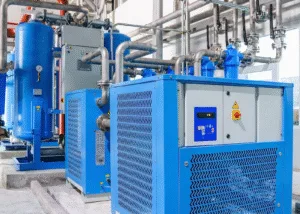
- With a compact, all-in-one design, Atlas Copco dryers are space-efficient and arrive ready for immediate use. Installation is fast and hassle-free. All critical components are easily accessible, and the use of high-quality desiccant and long-lasting valves ensures extended service intervals—often exceeding three years.