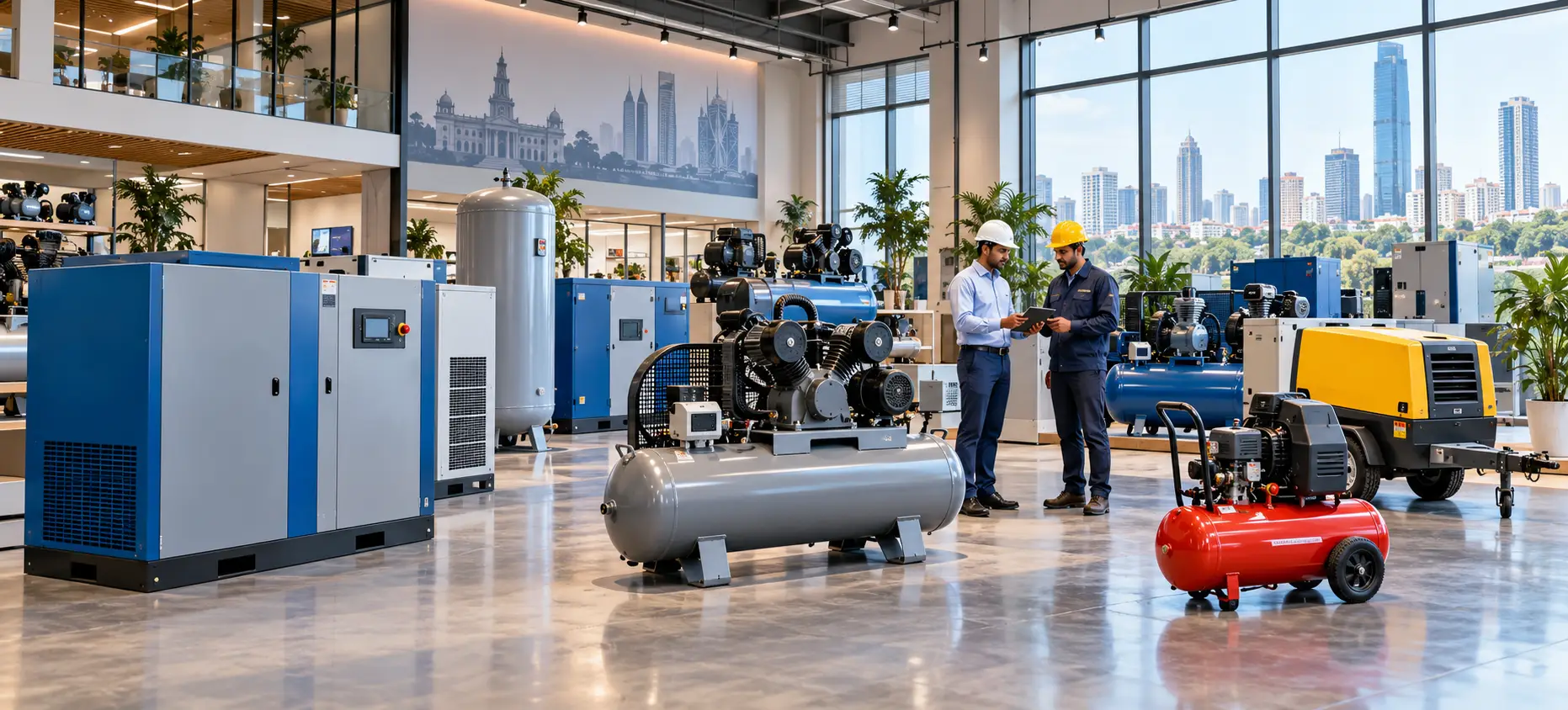
Centrifugal Air Compressor for High-Capacity Industrial Compressed Air Systems
A centrifugal air compressor is a dynamic compressor designed to generate compressed air by transferring energy from a high-speed rotating impeller to the air and converting that velocity into pressure.
Share your airflow, working pressure, demand profile and application – our team will respond to your requirement.
Atlas Copco partner since 2002 (20+ years)
Exclusive CALMS Systems India representative
500+ projects delivered
Since 2002Industrial compressed air solutions
20+ yearsAuthorized Atlas Copco partner
500+Projects delivered
CALMSExclusive India representative
Centrifugal Compressor Technology for Industrial Compressed Air
For industrial facilities with substantial and relatively consistent compressed-air requirements, centrifugal compressor technology can be an important option to evaluate.
Unlike a reciprocating compressor that compresses trapped volumes using pistons, or a rotary screw compressor that uses intermeshing rotors, a centrifugal compressor operates through continuous dynamic compression.
This fundamental difference influences:
Capacity
Operating characteristics
Control strategy
Compressor selection
System design
Maintenance requirements
Application suitability
ASG Energy Solutions supports industrial customers evaluating compressed air equipment and complete compressed air systems according to actual plant requirements.
A centrifugal compressor selection should consider more than the compressor itself.
The complete requirement can involve:
Required airflow
Working pressure
Minimum air demand
Average air demand
Peak demand
Demand variation
Operating hours
Compressed-air quality
Cooling requirements
Air treatment
Air receivers
Distribution piping
Compressor sequencing
Redundancy
Future expansion
Maintenance strategy
For high-capacity installations, understanding the plant air-demand profile is particularly important.
A centrifugal air compressor is a dynamic compressor.
It uses rapidly rotating impellers to accelerate incoming air.
The high-velocity air then passes through components designed to convert part of that velocity into increased static pressure.
This compression process can be repeated through multiple stages when the required final pressure calls for staged compression.
The technology is therefore fundamentally different from positive-displacement compressors.
Positive-displacement compressors capture a volume of air and mechanically reduce its volume.
Centrifugal compressors continuously transfer kinetic energy to the air.
Centrifugal Compressor Working Principle
Understanding the centrifugal compressor working principle helps buyers understand why this technology behaves differently from screw and reciprocating compressors.
The broad compression sequence is:
Air enters the compressor inlet.
The air approaches the rotating impeller.
The impeller transfers mechanical energy to the air.
Air velocity increases significantly.
The high-velocity air moves into a diffuser.
The diffuser slows the airflow in a controlled manner.
Part of the velocity energy is converted into static pressure.
Where additional pressure is required, the air can move to another compression stage.
After the final stage, the compressed air is delivered to the downstream compressed air system.
This is the basic principle behind centrifugal compression.
Centrifugal Compressor Impeller
The centrifugal compressor impeller is one of the central components of the compression process.
The impeller rotates at high speed and transfers energy to the incoming air.
As the air moves through the impeller, its velocity increases.
The design of an impeller is closely related to the compressor's intended:
Flow
Pressure
Speed
Operating range
Stage design
The impeller is a precision component.
Inspection, repair or replacement should be handled according to the compressor manufacturer's technical requirements.
Compressor Impeller and Airflow
The impeller should not be considered as a simple fan.
Its geometry, rotational speed and relationship with the diffuser are engineered to produce the required compression performance.
Changes in operating conditions can affect how the compressor operates relative to its designed performance range.
This is one reason centrifugal compressor selection requires a clear understanding of expected plant demand.
What Does the Diffuser Do?
After leaving the impeller, the air has substantial velocity.
The diffuser is designed to reduce this velocity in a controlled way and convert kinetic energy into static pressure.
The impeller and diffuser therefore perform complementary functions:
Impeller: Adds energy and velocity
Diffuser: Converts velocity into pressure
This process is central to centrifugal compressor operation.
Centrifugal Type, Gas Compressor and Turbo Compressor Terminology
Centrifugal Type Compressor
The phrase centrifugal type compressor refers to a dynamic compressor configuration using centrifugal force and aerodynamic energy transfer.
Centrifugal compressors can be designed for:
Compressed air
Process gases
Different pressure requirements
Different flow ranges
This page focuses primarily on centrifugal compressors used for industrial compressed air.
Centrifugal Air Compressor vs Centrifugal Gas Compressor
A centrifugal air compressor specifically handles air.
A centrifugal gas compressor can be designed for process gases other than atmospheric air.
Although the basic dynamic compression principles can be related, gas properties, sealing requirements, materials, process conditions and system design can differ significantly.
A compressed-air compressor should therefore not be assumed to be suitable for process-gas service.
Turbo Compressors
The term turbo compressor is frequently used for dynamic compressor technology.
Centrifugal compressors are commonly associated with turbo-compressor terminology because they use high-speed rotating components to transfer energy to the gas.
Search terms such as:
Turbo compressors
Turbo air compressor
Turbo centrifugal compressor
Centrifugal turbo compressor
Industrial turbo compressor
often relate to centrifugal compression technology.
Industrial, High-Capacity Centrifugal Compressor Capacity, Performance and Specifications
Industrial Centrifugal Air Compressor
An industrial centrifugal air compressor can be considered where a plant has substantial compressed-air demand.
Potential operating environments include:
Large manufacturing plants
Process industries
Power-generation facilities
Steel plants
Cement plants
Chemical facilities
Petrochemical facilities
Refineries
Textile plants
Pharmaceutical manufacturing
Large central utility systems
The suitability of centrifugal technology depends on the actual demand profile rather than industry name alone.
High Capacity Centrifugal Air Compressor
Centrifugal compressors are particularly relevant to high-flow compressed-air applications.
However, “high capacity” should be defined using measurable airflow rather than a generic description.
Industrial airflow can be expressed in:
CFM
m³/min
m³/h
Other standardised flow units
When comparing compressors, buyers should ensure the airflow ratings use appropriate reference conditions.
Centrifugal Compressor Capacity
Centrifugal compressor capacity should be evaluated at the required operating pressure and under relevant inlet conditions.
Capacity requirements should consider:
Base demand
Average demand
Peak demand
Minimum demand
Future expansion
Backup strategy
A plant's maximum theoretical demand does not always represent the best basis for compressor selection.
Likewise, average demand alone may overlook important peaks.
Why Air Demand Profile Matters
A centrifugal compressor has an operating envelope.
The plant should therefore understand how air demand changes throughout:
Production cycles
Shifts
Weekdays
Maintenance periods
Seasonal conditions
A facility with a large, stable base load may present a different compressor opportunity from a facility where demand changes rapidly across a very wide range.
Centrifugal Compressor Performance
Centrifugal compressor performance is influenced by multiple factors.
These can include:
Inlet temperature
Inlet pressure
Air density
Humidity
Operating pressure
Flow requirement
Cooling conditions
Compressor condition
Control position
This means compressor performance should be considered under the expected site conditions.
Centrifugal Compressor Specifications
When evaluating centrifugal compressor specifications, buyers should review more than motor power.
Relevant parameters can include:
Rated airflow
Operating pressure
Motor power
Number of compression stages
Cooling arrangement
Control system
Inlet conditions
Discharge conditions
Sound information
Dimensions
Electrical requirements
Air-treatment requirements
Service requirements
The most important specifications depend on the application.
Single Stage, Two Stage, Three Stage and Multistage Centrifugal Compressors
Air inlet
Stage 1
Intercooler
Stage 2
Intercooler
Stage 3
Aftercooler
Single Stage Centrifugal Compressor
A single stage centrifugal compressor uses one primary centrifugal compression stage.
Whether one stage is appropriate depends on the required pressure ratio and compressor design.
Single-stage centrifugal compression should not be confused with single-stage piston compression because the technologies operate differently.
Two Stage Centrifugal Compressor
A two stage centrifugal compressor uses two compression stages.
A general arrangement can involve:
First-stage compression
Intercooling
Second-stage compression
Final cooling
Cooling between stages can help manage air temperature and compression conditions.
Three Stage Centrifugal Compressor
A three stage centrifugal compressor uses three compression stages to achieve the required final pressure according to the machine design.
Between stages, intercooling can reduce compressed-air temperature before the air enters the next compression stage.
The exact architecture varies by compressor design.
Multistage Centrifugal Compressor
A multistage centrifugal compressor uses multiple impeller and diffuser stages.
Multistage compression can be used where the required pressure cannot be achieved appropriately through a single stage.
Important considerations include:
Stage pressure ratio
Interstage cooling
Condensate management
Operating range
Controls
Final discharge pressure
Why Intercooling Is Used
Compressing air increases its temperature.
Intercooling between compression stages removes heat before the air enters the next stage.
This can help manage:
Discharge temperature
Compression conditions
Overall compressor operation
Cooling also causes moisture in the compressed air to condense.
Interstage condensate management is therefore important.
Aftercooling in Centrifugal Air Compressors
After the final compression stage, an aftercooler can reduce the compressed-air discharge temperature.
As air cools, water vapour can condense.
The system therefore needs appropriate:
Moisture separation
Condensate drainage
Downstream air treatment
An oil-free compressor does not mean moisture-free compressed air.
Oil Free, Electric, High Pressure and Heavy Duty Centrifugal Compressors
Oil Free Centrifugal Air Compressor
An oil free centrifugal air compressor is designed so that lubricating oil is not introduced into the compressed-air path according to the compressor design.
This makes centrifugal technology relevant to industrial applications where avoiding lubricant introduced during compression is an important requirement.
However, “oil free” does not mean the entire machine contains no lubricant.
Bearings, gears or other mechanical components can use lubrication while remaining separated from the compressed-air path.
Oil Free Does Not Mean Dry Compressed Air
Atmospheric air contains water vapour.
When air is compressed and subsequently cooled, moisture can condense.
Therefore, an oil-free centrifugal compressor can still require:
Aftercooling
Moisture separation
Air receivers
Air dryers
Condensate drains
Oil contamination and moisture are separate compressed-air-quality considerations.
Oil Free Does Not Automatically Mean Particle Free
The compressor takes in atmospheric air.
That air can contain:
Dust
Particles
Other airborne contaminants
Intake filtration protects the compressor.
Additional downstream filtration may be required according to the application's compressed-air-quality requirements.
Electric Centrifugal Air Compressor
Industrial centrifugal air compressors are commonly driven by electric motors.
An electric centrifugal air compressor installation requires consideration of:
Electrical supply
Motor rating
Starting method or drive configuration
Protection systems
Plant electrical infrastructure
Control integration
Electrical design and installation should be completed by qualified personnel according to applicable requirements.
High Pressure Centrifugal Compressor
Centrifugal compressor technology can be engineered for different pressure requirements.
However, not every centrifugal compressor is suitable for every pressure.
A high pressure centrifugal compressor requirement should define:
Required discharge pressure
Required airflow at that pressure
Inlet conditions
Application
Operating profile
Specialised applications may require purpose-designed compressor systems.
High Efficiency Centrifugal Compressor
Searches for a high efficiency centrifugal compressor should be approached carefully.
Efficiency depends on more than a product label.
Actual system performance can be influenced by:
Compressor selection
Operating point
Plant demand
Pressure setpoint
Controls
Cooling conditions
Pressure drop
Maintenance
Air leaks
A technically appropriate compressor operating near a suitable range can perform very differently from a poorly matched compressor.
No generic energy-saving percentage should be assumed.
Energy Efficient Centrifugal Air Compressor
Energy performance should be evaluated across the complete compressed air system.
A plant can investigate:
Actual air demand
Operating pressure
Compressor loading
Compressor sequencing
Air leakage
Artificial demand
Filter pressure drop
Dryer pressure drop
Piping pressure drop
Cooling conditions
Changing the compressor alone may not address all system losses.
Heavy Duty Centrifugal Air Compressor
“Heavy duty” is a broad commercial phrase rather than a precise compressor specification.
For industrial purchasing, define the requirement using:
Airflow
Pressure
Operating hours
Ambient conditions
Duty profile
Application
Redundancy
These factors provide a more useful basis for compressor selection.
Centrifugal Air Compressor System
A complete centrifugal air compressor system can include:
Air intake system
Centrifugal compressor
Intercoolers
Aftercooler
Moisture separators
Condensate drains
Air receiver
Compressed air dryer
Compressed air filters
Distribution piping
System controls
The exact configuration depends on plant requirements.
Centrifugal Compressed Air System
The compressor should not be evaluated independently from the rest of the compressed air installation.
A useful system view is:
Ambient Air
Compressor Intake
Centrifugal Compression Stages
Intercooling
Aftercooling
Moisture Separation
Air Receiver
Air Treatment
Distribution Network
Production
Each section can affect system performance.
Centrifugal Air Compressor Plant
For large facilities, the compressor installation may operate as a central utility plant.
A compressor plant can contain:
Multiple compressors
Air receivers
Dryers
Filters
Cooling systems
Condensate management
Master controls
Distribution headers
System-level planning becomes particularly important when several compressors operate together.
Centrifugal Compressor Control
Centrifugal compressor controls help manage compressor output and maintain operation within the intended operating range.
Control strategies vary by machine.
The system may monitor parameters such as:
Pressure
Flow-related operating conditions
Temperature
Vibration
Motor conditions
Valve positions
The specific control architecture depends on the compressor.
Inlet Guide Vanes
Applicable centrifugal compressors can use inlet guide vanes as part of capacity control.
Their purpose is to influence airflow entering the compression stage.
The exact control strategy depends on machine design.
Buyers should evaluate compressor turndown and operating characteristics against actual plant demand.
What Is Surge in a Centrifugal Compressor?
Surge is an unstable operating condition that can occur when a centrifugal compressor operates outside the appropriate low-flow region of its performance envelope.
It can involve unstable pressure and flow behaviour.
Surge is not a normal operating mode.
Centrifugal compressor systems therefore use controls designed to maintain operation within an acceptable range.
Why Surge Control Matters
Operating a centrifugal compressor requires attention to its designed operating envelope.
The control system can use anti-surge strategies to protect the compressor from unstable low-flow operation.
Surge-related settings and controls are equipment-specific and should be maintained according to the compressor manufacturer's requirements.
What Is Choke in a Centrifugal Compressor?
At the opposite side of the operating range, very high flow can approach another aerodynamic limitation commonly described as choke or stonewall.
The practical lesson for buyers is straightforward:
A centrifugal compressor has a defined operating range.
It should be selected so that expected plant demand can be handled appropriately within that range.
Centrifugal Compressor Performance Curve
A compressor performance curve represents the relationship between operating parameters such as flow and pressure under defined conditions.
The performance map can help engineers evaluate:
Expected operating point
Minimum operating range
Maximum flow region
Control behaviour
Performance curves are model-specific.
They should be reviewed using manufacturer data for the actual compressor under consideration.
Centrifugal Compressor vs Screw Compressor
One of the most common buyer searches is centrifugal compressor vs screw compressor.
Both technologies can serve industrial compressed-air applications, but they operate differently.
Consideration
Centrifugal Compressor
Rotary Screw Compressor
Compression principle
Dynamic
Positive displacement
Compression mechanism
High-speed impeller and diffuser
Intermeshing screw rotors
Typical role
Often considered for substantial industrial air demand
Used across a broad range of industrial capacities
Airflow behaviour
Best evaluated against compressor operating map
Broad industrial operating flexibility depending on design
Oil-free options
Available
Available
Variable demand
Requires careful operating-range and control assessment
Fixed-speed and variable-speed configurations available
Maintenance
Technology-specific specialised maintenance
Technology-specific preventive maintenance
Selection basis
Flow, pressure and operating profile
Flow, pressure and operating profile
Neither technology is automatically superior.
The correct selection depends on plant demand.
When Can a Centrifugal Compressor Be Considered Instead of a Screw Compressor?
Centrifugal technology can be evaluated when:
Plant airflow demand is substantial
A significant base load exists
Oil-free compression is required
The operating profile suits centrifugal technology
A central compressor plant is being planned
Existing high-capacity equipment is being replaced
A screw compressor may be more suitable where the capacity range or demand profile better matches screw technology.
The decision should be data-driven.
Centrifugal Compressor vs Reciprocating Compressor
A reciprocating compressor uses pistons moving inside cylinders.
A centrifugal compressor uses rotating impellers and aerodynamic compression.
Consideration
Centrifugal
Reciprocating
Type
Dynamic
Positive displacement
Main compression element
Impeller
Piston and cylinder
Flow characteristic
Continuous dynamic flow
Pulsating displacement
Typical industrial positioning
High-flow applications
Wide range including specialised pressure applications
Mechanical arrangement
High-speed rotating system
Reciprocating mechanical system
Selection
Flow, pressure and operating range
Flow, pressure, duty and stages
The required capacity and pressure determine which technology deserves consideration.
Centrifugal Compressor Applications
Several important application categories apply to centrifugal compressors.
Potential applications include:
Manufacturing
Power plants
Chemical processing
Petrochemical industries
Oil and gas
Steel plants
Cement plants
Textile manufacturing
Pharmaceutical manufacturing
Refineries
Process industries
Application suitability should always be confirmed using actual flow, pressure, air-quality and operating requirements.
Centrifugal Air Compressor for Manufacturing
Large manufacturing plants can use substantial quantities of compressed air for:
Automation
Pneumatic controls
Production machinery
Instrumentation
Material handling
Packaging
General plant air
A centrifugal compressor can be evaluated where the overall demand profile suits high-capacity dynamic compression.
Centrifugal Air Compressor for Power Plant
Power-generation facilities can have compressed-air requirements involving:
Instrument air
Service air
Pneumatic equipment
Maintenance utilities
The required reliability, air quality, pressure and redundancy should be defined before compressor selection.
Centrifugal Air Compressor for Chemical Industry
Chemical manufacturing facilities can have multiple compressed-air requirements.
The application should distinguish between:
General plant compressed air
Instrument air
Process-related air
Process gas compression
A standard centrifugal air compressor should not be confused with a process gas compressor engineered for a particular gas.
Centrifugal Compressor for Petrochemical Industry
Petrochemical facilities can use centrifugal compressor technology for both compressed-air and specialised gas applications.
The technical requirements for these services can be very different.
For industrial compressed air, define:
Flow
Pressure
Air quality
Operating profile
Redundancy
Process-gas compression requires separate application-specific engineering.
Centrifugal Compressor for Oil and Gas
Oil and gas facilities can have demanding compressor applications.
A centrifugal compressor used for plant air is different from specialised process compressors handling hydrocarbons or other gases.
Equipment must be selected specifically for the intended service.
Centrifugal Air Compressor for Steel Plant
Steel manufacturing can require substantial compressed-air capacity for production and utility applications.
System planning should consider:
Large plant distribution networks
Pressure drop
Multiple demand areas
Production cycles
Air storage
Compressor sequencing
A high-capacity compressor should be integrated with the complete distribution system.
Centrifugal Air Compressor for Cement Plant
Cement facilities can have challenging environmental conditions involving airborne dust.
Compressor selection and installation planning should consider:
Intake-air conditions
Filtration
Cooling
Compressor-room cleanliness
Maintenance access
The actual compressed-air demand should also be measured or carefully estimated.
Centrifugal Air Compressor for Textile Industry
Textile manufacturing can involve compressed air across production machinery and pneumatic systems.
Where total demand is substantial, centrifugal technology can be evaluated alongside other industrial compressor technologies.
Centrifugal Air Compressor for Pharmaceutical Industry
Pharmaceutical facilities can have compressed-air requirements with defined air-quality expectations.
Oil-free centrifugal compression can be considered where appropriate, but the complete system may also require:
Drying
Filtration
Clean distribution
Monitoring according to process requirements
The required air quality should be defined for the actual application.
Centrifugal Compressor for Refinery
Refineries can have large utility systems.
Compressed-air applications can include plant and instrument air.
A refinery may also operate process gas compressors, which should not be confused with general industrial air compressors.
Selection should follow the specific service requirement.
Centrifugal Compressor for Process Industry
Process plants can operate continuously and may have significant base compressed-air demand.
Important considerations include:
Capacity
Pressure
Air quality
Redundancy
Maintenance planning
Operating range
System controls
A plant demand study can provide valuable information before compressor selection.
Continuous Operation, Base-Load and Multiple-Compressor Systems
Centrifugal Air Compressor for Continuous Operation
Centrifugal compressors are often considered in industrial environments with substantial operating hours.
For continuous operation, evaluate:
Actual base load
Cooling system
Operating range
Backup capacity
Maintenance windows
Control philosophy
Air-treatment equipment
No compressor should be selected solely because it is marketed as heavy duty or industrial.
Base-Load Compressor Applications
A large plant may operate several compressor technologies together.
A centrifugal compressor can potentially serve as part of the plant's base-load strategy where its capacity and operating range match the demand profile.
Other compressors can be used as:
Trim capacity
Backup capacity
Peak-demand support
The optimum sequencing arrangement depends on the installed equipment and demand pattern.
Multiple Centrifugal Compressors
Facilities with very high demand can operate multiple centrifugal compressors.
A multi-compressor installation requires coordinated control.
Poor sequencing can result in compressors operating at undesirable points or unnecessary capacity being online.
A master control strategy can be considered where appropriate.
Centrifugal Compressor and Screw Compressor Combination
A plant does not necessarily have to choose only one compressor technology.
In some installations, different compressor technologies can perform different roles.
For example, one compressor may support a stable base load while another responds to changing demand.
The appropriate combination depends on actual system data.
Air Receivers, Dryers, Filters and Piping for Centrifugal Compressor Systems
Air Receiver with Centrifugal Compressor
An air receiver stores compressed air.
Receiver requirements depend on:
System demand
Control strategy
Plant volume
Demand fluctuations
Compressor arrangement
A receiver should not be treated as a substitute for inadequate compressor capacity.
Centrifugal Compressor with Air Dryer
Even when centrifugal compression is oil-free, moisture remains an important issue.
An air dryer may be required depending on the target pressure dew point.
Common dryer categories include:
Refrigerated air dryers
Desiccant air dryers
The dryer should be selected for the actual flow, pressure, temperature and dew-point requirement.
Refrigerated Dryer for Centrifugal Compressor
A refrigerated dryer can be suitable for many general industrial compressed-air applications.
For large centrifugal systems, dryer capacity and pressure drop become important selection considerations.
The dryer should be sized for actual operating conditions rather than compressor motor power alone.
Desiccant Dryer for Centrifugal Compressor
A desiccant dryer can be considered where a lower pressure dew point is required.
Dryer selection should account for:
Required flow
Operating pressure
Inlet temperature
Target dew point
Dryer technology
Regeneration requirements
The complete air-treatment system should be considered during compressor-plant design.
Compressed Air Filters with Centrifugal Compressor
Oil-free centrifugal compression does not eliminate every form of contamination.
Depending on application requirements, downstream filtration can address:
Particles
Other specified contaminants
Filter selection should match the required compressed-air quality.
Pressure drop across filtration equipment should also be considered.
Compressed Air Piping for Centrifugal Systems
High-capacity compressors require appropriately sized distribution systems.
Poor piping design can create:
Excessive pressure drop
Uneven pressure
Flow restrictions
Difficulty serving peak demand
Piping design considerations include:
Pipe diameter
Header arrangement
Pipe length
Fittings
Flow
Pressure
Future expansion
A large compressor cannot overcome every distribution-system problem efficiently.
Installation, Compressor Room Planning and Cooling Requirements
Centrifugal Air Compressor Installation
A centrifugal air compressor installation requires careful site planning.
Important considerations include:
Foundation or mounting requirements
Equipment access
Ventilation
Cooling system
Electrical supply
Piping
Drainage
Air treatment
Service clearances
Lifting and maintenance access
Control integration
Manufacturer installation requirements should be followed for the specific machine.
Compressor Room Planning
A centrifugal compressor room should provide an environment appropriate for the installed equipment.
Consider:
Ventilation
Ambient temperature
Clean intake air
Service space
Cooling-system requirements
Drainage
Electrical access
Equipment movement
Poor installation conditions can affect compressor operation and maintenance.
Cooling Requirements
Centrifugal compression generates heat.
Cooling requirements depend on compressor design.
Systems may use different cooling arrangements.
The installation should provide the required cooling conditions and ensure coolers remain maintained.
Cooling problems can contribute to elevated operating temperatures and reduced operating margin.
Centrifugal Compressor Maintenance
Centrifugal compressor maintenance should follow the specific compressor manufacturer's schedule and procedures.
Maintenance can involve inspection of:
Air intake system
Cooling system
Bearings
Lubrication system where applicable
Controls
Valves
Sensors
Intercoolers
Aftercooler
Condensate drains
Vibration condition
Electrical equipment
The exact scope varies by machine.
Preventive Maintenance for Centrifugal Compressors
A preventive maintenance program can include:
Operating-data review
Alarm-history review
Filter inspection
Cooling-system inspection
Drain checks
Lubrication-system checks where applicable
Control-system checks
Vibration monitoring where applicable
Scheduled component inspections
Maintenance intervals should follow the installed equipment requirements.
Centrifugal Compressor Condition Monitoring
Large rotating equipment can benefit from condition monitoring.
Depending on the compressor, monitored parameters can include:
Vibration
Bearing condition
Temperatures
Pressure
Operating position
Motor conditions
Trends can be more informative than isolated readings.
Any alarm should be investigated according to the equipment's service requirements.
Abnormal vibration can indicate a condition requiring technical assessment.
Potential causes vary widely and should not be diagnosed through assumption.
Inspection and corrective work should be performed by qualified personnel familiar with the specific compressor.
Centrifugal Compressor Repair
Repair should begin with diagnosis.
Common reported conditions can include:
Reduced capacity
High discharge temperature
Abnormal vibration
Control alarms
Cooling problems
Pressure instability
Failure to achieve required output
These symptoms can have multiple causes.
Replacing parts without diagnosis can increase downtime and cost.
Centrifugal Compressor Overhaul
A centrifugal compressor overhaul is a specialised maintenance activity.
Depending on compressor design and condition, overhaul work can involve inspection of major rotating and mechanical components.
This is not comparable to routine filter replacement on a smaller compressor.
Major overhaul work should follow equipment-specific procedures and be performed by appropriately qualified service personnel.
Centrifugal Air Compressor Spare Parts
Spare-parts requirements can include:
Air intake components
Filters
Valves
Sensors
Control components
Cooling-system components
Drain components
Bearing-related components
Equipment-specific service parts
The exact compressor make, model and equipment identification should be provided when requesting spare parts.
Centrifugal Compressor Impeller Repair
An impeller is a precision rotating component.
Damage or suspected impeller problems require specialised assessment.
It should not be casually:
Ground
Welded
Machined
Reshaped
Balanced using improvised methods
Any repair or replacement should follow applicable manufacturer and engineering requirements.
Centrifugal Compressor Service
Professional service should consider both the compressor and its operating environment.
A service assessment can review:
Compressor operating data
Air demand
Pressure
Cooling conditions
Air treatment
Controls
Maintenance history
Alarm history
This broader view helps distinguish equipment problems from system problems.
Centrifugal Air Compressor Rental
Buyers also search for centrifugal air compressor rental.
Rental requirements for high-capacity compressed air should define:
Required airflow
Pressure
Duration
Installation conditions
Air-quality requirements
Electrical or drive requirements
Connection requirements
Rental availability should be confirmed for the specific requirement rather than assumed.
Centrifugal Air Compressor Price
There is no single centrifugal air compressor price applicable to every installation.
Pricing can vary according to:
Required airflow
Operating pressure
Number of stages
Motor rating
Compressor configuration
Control system
Cooling arrangement
Included accessories
Air treatment
Installation scope
Application requirements
A technically meaningful quotation therefore begins with flow and pressure.
Centrifugal Air Compressor Price in India
When requesting a centrifugal air compressor price in India, buyers should provide a clear technical requirement.
Useful information includes:
Required airflow
Required pressure
Application
Operating hours
Minimum demand
Average demand
Peak demand
Air-quality requirement
Cooling conditions
Electrical supply
Existing compressor details
Future expansion
This allows different proposals to be compared more effectively.
Why Centrifugal Compressor Prices Vary
Two centrifugal compressors should not be considered equivalent simply because they have similar motor ratings.
Differences can include:
Delivered airflow
Pressure
Number of stages
Control capability
Operating range
Cooling system
Included equipment
Installation requirements
Compare technical scope before comparing price.
Centrifugal Air Compressor for Sale
Buyers searching for a centrifugal air compressor for sale should first determine whether centrifugal technology is suitable for the plant demand.
Before requesting equipment, answer:
What airflow is required?
At what pressure?
How stable is demand?
How many hours will the compressor operate?
What is the minimum demand?
Is oil-free compression required?
What air treatment is required?
Is backup capacity available?
What future expansion is planned?
This creates a stronger purchasing specification.
Centrifugal Air Compressor Suppliers, Manufacturers and Dealers
Centrifugal Air Compressor Near Me
Local searches such as centrifugal air compressor near me often indicate immediate commercial intent.
However, geographic proximity should not be the only selection criterion.
Industrial buyers should also evaluate:
Technical suitability
Capacity
Pressure
System integration
Service requirements
Installation support
Maintenance planning
High-capacity compressor selection should be based primarily on the plant requirement.
Centrifugal Air Compressor Manufacturers
A centrifugal air compressor manufacturer designs and manufactures centrifugal compressor equipment.
A supplier or solutions provider may supply or support equipment from a manufacturer.
These terms should not be used interchangeably.
ASG Energy Solutions is positioned according to its actual role in compressed air equipment supply and system support, and is not represented as the manufacturer of third-party centrifugal compressors.
Centrifugal Air Compressor Suppliers
A capable centrifugal air compressor supplier should understand that high-capacity compressor selection begins with plant data.
Important supplier discussions should include:
Flow
Pressure
Demand profile
Operating range
Air quality
Cooling
Air treatment
Distribution
Maintenance
Expansion
Simply matching compressor motor power to an existing machine may overlook important system conditions.
Centrifugal Air Compressor Dealers
Buyers searching for centrifugal compressor dealers should determine exactly what support is required.
The project may involve:
New compressor purchase
Existing compressor replacement
Capacity expansion
Complete compressor plant
Air-treatment upgrade
System optimisation
Service requirement
The required scope affects supplier selection.
Centrifugal Air Compressor Manufacturers in India
Industrial buyers in India often search for centrifugal air compressor manufacturers in India, suppliers, dealers, companies and price information.
When comparing equipment from different manufacturers, evaluate:
Rated flow
Required pressure
Operating range
Control method
Stage configuration
Cooling requirements
Air quality
Maintenance requirements
System compatibility
Avoid comparing equipment only on headline price.
Centrifugal Air Compressor Suppliers in India
Industrial buyers can benefit from preparing a written compressed-air specification before contacting suppliers.
Industrial facilities searching for a centrifugal air compressor in Bangalore may be evaluating equipment for:
Manufacturing
Engineering
Pharmaceutical production
Electronics manufacturing
Process industries
Large industrial utility systems
The correct compressor should be selected according to actual plant air demand rather than location alone.
Centrifugal Air Compressor Suppliers in Bangalore
Businesses searching for centrifugal air compressor suppliers in Bangalore should prepare operating data before requesting a proposal.
Useful information includes:
Existing compressor details
Current airflow where known
Current operating pressure
Production operating hours
Pressure problems
Minimum demand
Peak demand
Future expansion
Required compressed-air quality
ASG Energy Solutions can support discussions around industrial compressed air requirements and system configuration.
Centrifugal Air Compressor Manufacturers in Bangalore
Searches for centrifugal air compressor manufacturers in Bangalore can include buyers seeking either a manufacturer or a local equipment supplier.
These are different commercial roles.
Where equipment is manufactured by a third-party compressor manufacturer, ASG Energy Solutions acts as a supplier or compressed air solutions provider, not as the compressor manufacturer.
Best Centrifugal Air Compressor
There is no universal best centrifugal air compressor for every industrial facility.
The best technical fit is the compressor that appropriately matches:
Required airflow
Required pressure
Demand profile
Air quality
Operating range
Site conditions
Maintenance strategy
System design
A high-capacity compressor that is poorly matched to plant demand is not automatically a better choice because it has greater nominal capacity.
How to Compare Centrifugal Compressor Suppliers
Application Knowledge
Does the supplier understand the plant's compressed-air use?
Demand Assessment
Is compressor selection based on flow and demand profile?
Pressure Evaluation
Is the actual required pressure being considered?
Technology Selection
Has centrifugal technology been compared with other appropriate compressor options?
Air Treatment
Are moisture and filtration requirements included?
Controls
Is compressor operating range and system control considered?
Installation
Are cooling, electrical, piping and service-space requirements reviewed?
Maintenance
Is the long-term service requirement understood?
These criteria provide a more useful comparison than unsupported “best supplier” claims.
Design, Efficiency, Advantages and Limitations
Centrifugal Compressor Design Considerations
Detailed centrifugal compressor design is a specialised engineering discipline.
From a buyer's perspective, important design-related concepts include:
Impeller stages
Diffusers
Intercooling
Operating range
Control system
Bearings
Cooling
Air path
Motor and drive arrangement
The buyer generally does not need to redesign these components.
Instead, the objective is to specify the operating requirement accurately so suitable equipment can be selected.
Centrifugal Compressor Efficiency
Centrifugal compressor efficiency is an important consideration for industrial buyers.
Efficiency should be evaluated under realistic operating conditions.
Important questions include:
At what flow will the compressor normally operate?
At what pressure?
How frequently does demand vary?
What happens at minimum demand?
How are multiple compressors sequenced?
What pressure losses exist downstream?
A single efficiency claim cannot describe every operating condition.
Centrifugal Compressor Advantages
Potential advantages of centrifugal compressor technology can include suitability for:
High compressed-air flow
Continuous dynamic compression
Oil-free compressed-air configurations
Large central compressor systems
Industrial base-load applications where the operating profile is appropriate
These advantages are application-dependent.
They should not be interpreted as meaning centrifugal compressors are preferable for every plant.
Centrifugal Compressor Limitations and Buying Considerations
Important considerations include:
Operating range
Minimum-flow behaviour
Control requirements
Application-specific sizing
Specialised maintenance
High-speed rotating equipment
Cooling requirements
A plant with highly variable demand may require careful system design to ensure the compressor arrangement can follow the actual load appropriately.
Common Centrifugal Compressor Selection Mistakes
Selecting by Motor Power Alone
Motor power does not define the complete compressor performance.
Ignoring Minimum Demand
Maximum demand is only part of the load profile.
Ignoring the Operating Range
Centrifugal compressor performance should be evaluated across expected operating conditions.
Assuming Oil Free Means Dry Air
Moisture remains in compressed air.
Ignoring Cooling Requirements
Compression generates heat and the compressor requires appropriate cooling conditions.
Ignoring Pressure Drop
Filters, dryers and piping can reduce pressure available to production.
Oversizing Without Demand Analysis
More compressor capacity is not automatically better.
Ignoring Redundancy
Critical production may require a defined backup strategy.
Comparing Price Without Comparing Scope
Different quotations can include very different equipment and accessories.
Ignoring Maintenance Access
Large equipment requires appropriate service space.
Centrifugal Air Compressor Selection Workflow
01
Step 1Define the Application
Identify how compressed air is used.
02
Step 2Determine Current Air Demand
Use measured data where available.
03
Step 3Determine Minimum Demand
Understand low-load periods.
04
Step 4Determine Average Demand
Identify the normal operating requirement.
05
Step 5Determine Peak Demand
Document production peaks.
06
Step 6Define Working Pressure
Identify actual point-of-use pressure requirements.
07
Step 7Review Pressure Drop
Consider piping, filters and dryers.
08
Step 8Define Air Quality
Determine moisture and filtration requirements.
09
Step 9Review Compressor Technologies
Compare centrifugal technology with appropriate alternatives.
10
Step 10Evaluate Operating Range
Confirm the compressor can operate appropriately across expected demand.
11
Step 11Define Air Treatment
Select dryer and filtration requirements.
12
Step 12Review Air Storage
Determine receiver requirements.
13
Step 13Plan Controls
Review individual and multi-compressor control requirements.
14
Step 14Review Site Conditions
Consider ambient conditions, cooling, electrical supply and available space.
15
Step 15Plan Redundancy
Define the required backup strategy.
16
Step 16Consider Future Expansion
Include known production plans without excessive oversizing.
17
Step 17Review Maintenance
Consider service access, maintenance schedule and spare-parts requirements.
18
Step 18Compare Technical Proposals
Compare equivalent flow, pressure, equipment scope and operating conditions.
Centrifugal Compressor Buying Checklist
Before requesting a quotation, prepare:
Industry
Application
Existing compressor make and model
Existing compressor capacity
Required airflow
Required pressure
Minimum demand
Average demand
Peak demand
Daily operating hours
Number of shifts
Required air quality
Required pressure dew point
Air receiver requirement
Dryer requirement
Filter requirement
Cooling conditions
Electrical supply
Compressor-room conditions
Available installation space
Existing piping size
Future production expansion
Backup compressor details
Service expectations
This information makes compressor selection more meaningful.
Replacement, Capacity Expansion, Air Leak Management and Pressure Optimisation
Centrifugal Compressor Replacement
Replacing an existing centrifugal compressor is an opportunity to review the actual system requirement.
Do not automatically purchase the same capacity because the existing compressor has that rating.
Plant conditions may have changed.
Production may have expanded.
Some equipment may have been removed.
Leaks may have increased.
Pressure requirements may have changed.
Air-treatment equipment may create additional pressure drop.
A replacement project should therefore begin with current operating data.
Centrifugal Compressor Capacity Expansion
When production expands, the plant should determine whether additional compressor capacity is actually required.
Review:
Existing compressor loading
Peak demand
Leakage
Pressure drop
Available standby capacity
Production expansion requirements
If additional capacity is justified, evaluate how the new compressor will interact with existing equipment.
Centrifugal Compressor and Air Leak Management
Compressed-air leaks increase plant demand.
Even a highly efficient compressor must generate additional air to replace leaked compressed air.
Leak management should therefore be part of compressor-system optimisation.
Common leak locations can include:
Hose connections
Couplings
Pipe joints
Drain valves
Pneumatic equipment
Reducing unnecessary demand can influence future compressor capacity requirements.
Centrifugal Compressor and Pressure Optimisation
Higher pressure should not be used automatically to compensate for poor distribution.
Before increasing compressor pressure, investigate:
Piping restrictions
Dirty filters
Dryer pressure drop
Partially closed valves
Undersized distribution lines
Peak demand
Leaks
The goal is to deliver the required pressure to production without unnecessary system pressure.
Troubleshooting should evaluate both the compressor and the compressed-air system.
For example, low pressure can originate from:
Excessive plant demand
Air leaks
Downstream restrictions
Compressor performance
Control settings
Distribution problems
Diagnosis should precede major repair.
Why Choose ASG Energy Solutions for Centrifugal Air Compressor Requirements?
ASG Energy Solutions supports industrial compressed air requirements with an application-focused approach.
System-Based Evaluation
A centrifugal compressor should be considered as part of the complete compressed-air installation.
Flow and Pressure Focus
Equipment selection begins with actual airflow and operating-pressure requirements.
Demand Profile Consideration
Minimum, average and peak demand are important when evaluating centrifugal compressor suitability.
Air Treatment Planning
Moisture, drying and filtration requirements can be considered alongside compressor selection.
Receiver and Distribution Considerations
Air storage and piping influence complete system performance.
Maintenance Perspective
Long-term compressor operation requires preventive maintenance and appropriate service planning.
Industrial Application Focus
The selection process can account for operating hours, production requirements, expansion and system configuration.
ASG Energy Solutions should be evaluated according to the specific equipment and service scope required for the project.
Frequently Asked Questions About Centrifugal Air Compressors
A centrifugal air compressor is a dynamic compressor that uses high-speed rotating impellers to add energy to air and diffusers to convert velocity into increased pressure.
Air enters the compressor, is accelerated by an impeller and then passes through a diffuser where part of its velocity is converted into static pressure.
No. It is a dynamic compressor.
Turbo compressor is a term commonly associated with dynamic compressors that use high-speed rotating elements. Centrifugal compressors fall within this broad technology category.
The impeller is the rotating component that transfers mechanical energy to the air and increases its velocity.
The diffuser slows high-velocity air in a controlled manner and converts part of its kinetic energy into static pressure.
It uses more than one centrifugal compression stage to achieve the required pressure according to the compressor design.
It uses two compression stages, typically with cooling between stages according to the machine configuration.
It uses three compression stages, with the overall pressure increase distributed across those stages.
Intercoolers remove heat between compression stages and help manage the air conditions entering the next stage.
Industrial systems commonly use aftercooling to reduce discharge-air temperature. The exact configuration depends on the compressor.
Oil-free centrifugal compressor designs are available. The specific compressor design should be verified when oil-free compression is required.
Not necessarily. Lubricant can be used in isolated mechanical components while remaining separated from the compressed-air path.
No. Atmospheric moisture remains and can condense after compression.
A dryer may be required where the application has a defined moisture or pressure-dew-point requirement.
Filtration requirements depend on the compressor and the required downstream air quality.
Applications can include manufacturing, power generation, chemical processing, petrochemicals, steel, cement, textiles, pharmaceuticals, refineries and other process industries.
They can be suitable where the plant's capacity, pressure and demand profile match centrifugal compressor characteristics.
They are commonly considered for substantial industrial operating requirements, but suitability must be confirmed for the specific compressor and load profile.
Centrifugal technology is generally associated with larger industrial requirements. Smaller workshops commonly evaluate other compressor technologies according to their airflow needs.
Capacity describes the airflow the compressor can deliver under defined operating conditions.
Sizing should consider minimum, average and peak airflow, operating pressure, air quality, site conditions, future demand and redundancy.
No. Motor power alone is not enough. Delivered airflow and pressure are essential.
Surge is an unstable low-flow operating condition outside the compressor's appropriate operating region.
No. The compressor control system is designed to maintain operation within an appropriate range and protect against unsuitable operating conditions.
It is a control strategy used to help keep a centrifugal compressor away from unstable surge operation. The specific implementation is equipment-dependent.
Choke refers to the high-flow limit region of centrifugal compressor operation.
It shows compressor operating relationships such as flow and pressure under defined conditions.
A centrifugal compressor must operate within its intended operating range, so low-demand periods can influence technology selection and control strategy.
A centrifugal compressor is a dynamic machine using impellers and diffusers. A screw compressor is a positive-displacement machine using intermeshing rotors.
Neither is universally better. The correct choice depends on airflow, pressure, demand profile, air quality and operating requirements.
Centrifugal compressors use dynamic compression through rotating impellers. Reciprocating compressors use pistons moving inside cylinders.
It can handle variation within its designed operating and control range. Plants with highly variable demand require careful system analysis.
Different compressor technologies can be integrated into a plant where their capacities and controls are appropriately coordinated.
It can be considered for base-load operation where plant demand and compressor operating characteristics align.
Receiver requirements depend on the complete compressed-air system and control strategy.
Receiver sizing depends on system capacity, demand fluctuations and control requirements.
Refrigerated or desiccant dryers can be considered depending on the required pressure dew point and application.
Yes, where the selected compressor and complete air-treatment system meet the application's technical requirements.
They can be used for applicable industrial compressed-air requirements such as plant or instrument air systems.
Yes, where the capacity and pressure requirements suit the compressor technology.
They can be considered for suitable compressed-air applications, with attention to intake conditions, filtration and plant demand.
Maintenance varies by equipment and can include intake, cooling, bearings, controls, valves, sensors, drains and other compressor-specific systems.
Service intervals should follow the requirements of the specific compressor manufacturer and operating conditions.
Possible causes vary and can include cooling conditions, fouling, environmental conditions or equipment-specific problems. Proper diagnosis is required.
High vibration can have multiple mechanical or operating causes and should be investigated by qualified service personnel.
Impeller assessment and repair are specialised activities and should follow the compressor manufacturer's and applicable engineering requirements.
Requirements depend on make and model and can include filters, valves, sensors, controls, cooling components and equipment-specific service parts.
Provide manufacturer, model, equipment identification, part number where available and the required component description.
Price depends on capacity, pressure, stage configuration, motor, controls, cooling system, accessories and project scope.
There is no universal price. A quotation should be based on required airflow, pressure, operating profile and system scope.
Differences in capacity, pressure, stages, controls, operating range, cooling and included equipment can significantly affect price.
Industrial compressor suppliers and compressed-air solution providers can support suitable equipment selection according to the project requirement.
Provide airflow, pressure, application, operating hours, minimum and peak demand, air quality, site conditions and existing compressor details.
Industrial customers in Bangalore can evaluate centrifugal compressor solutions through relevant compressor suppliers and compressed-air solution providers according to their technical requirements.
Compare technical understanding, compressor sizing, demand-profile analysis, air-treatment knowledge, system integration, maintenance support and quotation scope.
ASG Energy Solutions is a compressed-air solutions and equipment supply provider where applicable, and is not represented as the manufacturer of third-party centrifugal compressor equipment.
ASG Energy Solutions can support discussions around industrial compressed-air requirements, including airflow, pressure, air treatment, storage, distribution and system considerations.
Detailed Centrifugal Air Compressor Project Checklist
For a new centrifugal compressor project, document the following.
Existing Compressed Air System
Number of compressors
Compressor types
Existing capacities
Operating pressures
Compressor ages where relevant
Existing controls
Existing receivers
Existing dryers
Existing filters
Demand
Minimum demand
Average demand
Peak demand
Shift profile
Weekend demand
Seasonal variation
Planned expansion
Pressure
Compressor discharge pressure
Header pressure
Point-of-use pressure
Critical equipment pressure
Observed pressure drop
Air Quality
Moisture requirement
Pressure dew point
Filtration requirement
Application-specific air-quality requirement
Utilities
Electrical supply
Cooling arrangement
Drainage
Ventilation
Available floor space
Distribution
Main header size
Major branches
Long pipe runs
Known restrictions
Known pressure-drop problems
Reliability
Backup compressor capacity
Production criticality
Maintenance shutdown windows
Redundancy requirement
Commercial Scope
Compressor only
Compressor package
Air receiver
Dryer
Filters
Piping
Electrical scope
Installation support
Service requirement
A structured project specification reduces ambiguity when comparing compressor proposals.
Complete Centrifugal Compressed Air Workflow
A well-planned industrial compressed air project can follow this sequence:
01
Production Requirement
Determine what equipment consumes compressed air.
02
Demand Assessment
Establish minimum, average and peak airflow.
03
Pressure Requirement
Determine the pressure actually required at the point of use.
04
System Loss Review
Evaluate dryers, filters, piping and other pressure losses.
05
Technology Evaluation
Compare centrifugal, screw or other appropriate compressor technologies.
06
Centrifugal Compressor Selection
Where suitable, select the compressor according to capacity, pressure and operating range.
07
Cooling Design
Plan the required compressor cooling arrangement.
08
Air Storage
Determine appropriate receiver requirements.
09
Air Treatment
Select drying and filtration according to required compressed-air quality.
10
Distribution
Ensure piping can carry the required airflow without excessive pressure drop.
11
Controls
Plan compressor sequencing and operating control.
12
Installation
Provide suitable electrical, cooling, drainage, ventilation and maintenance access.
13
Commissioning
Verify operation according to equipment and project requirements.
14
Preventive Maintenance
Maintain the compressor and associated equipment according to applicable schedules.
15
Performance Review
Review pressure, demand, leakage and system operation as production changes.
Centrifugal Air Compressor Solutions
Looking for a Centrifugal Air Compressor?
If your industrial facility is evaluating a centrifugal air compressor, start with the actual compressed-air requirement.
Share:
Required airflow
Required working pressure
Application
Current compressor details
Minimum air demand
Average air demand
Peak air demand
Operating hours
Number of shifts
Air-quality requirement
Dryer requirement
Receiver requirement
Cooling conditions
Electrical supply
Existing compressed-air problems
Future expansion plans
ASG Energy Solutions can use this information to support a more meaningful discussion around industrial compressed-air equipment and system requirements.
Enquire for:
Centrifugal Air Compressor
Centrifugal Compressor
Industrial Centrifugal Air Compressor
Industrial Centrifugal Compressor
Oil Free Centrifugal Air Compressor
Oil Free Centrifugal Compressor
Turbo Compressor
Turbo Air Compressor
Turbo Centrifugal Compressor
Centrifugal Turbo Compressor
Multistage Centrifugal Compressor
Two Stage Centrifugal Compressor
Three Stage Centrifugal Compressor
High Capacity Centrifugal Air Compressor
High Pressure Centrifugal Compressor
Electric Centrifugal Air Compressor
Centrifugal Air Compressor System
Centrifugal Compressed Air System
Centrifugal Air Compressor Plant
Centrifugal Air Compressor for Manufacturing
Centrifugal Air Compressor for Power Plant
Centrifugal Air Compressor for Chemical Industry
Centrifugal Compressor for Petrochemical Industry
Centrifugal Air Compressor for Steel Plant
Centrifugal Air Compressor for Cement Plant
Centrifugal Air Compressor for Pharmaceutical Industry
Centrifugal Compressor for Process Industry
Centrifugal Air Compressor Price
Centrifugal Air Compressor Price in India
Centrifugal Air Compressor for Sale
Centrifugal Air Compressor Suppliers
Centrifugal Air Compressor Suppliers in India
Centrifugal Air Compressor Suppliers in Bangalore
Centrifugal Compressor Service
Centrifugal Compressor Maintenance
Centrifugal Compressor Spare Parts
Request a Centrifugal Air Compressor Quote
For a meaningful equipment discussion, provide your plant airflow, operating pressure, minimum and peak demand, operating hours and compressed-air-quality requirements.
ASG Energy Solutions Pvt. Ltd. is committed to continuous improvement and driving innovation in our services. We proudly offer specialized project and maintenance solutions, including: